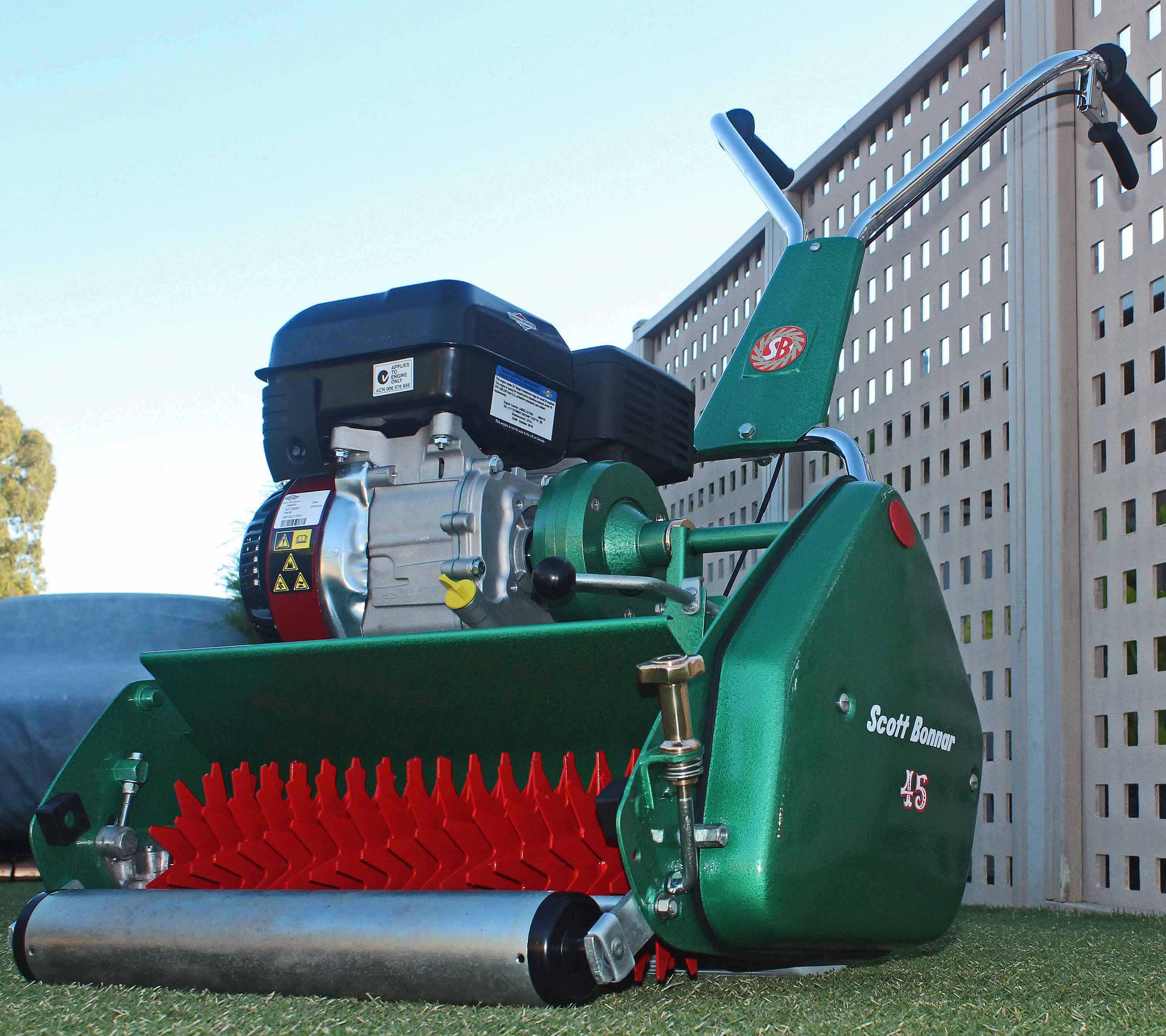
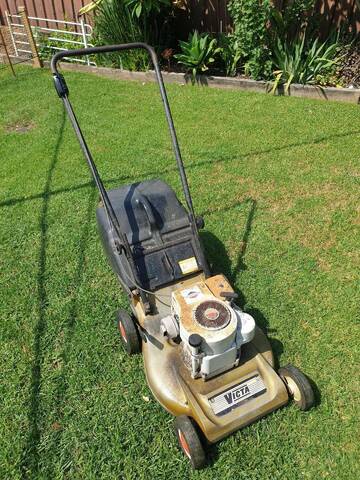
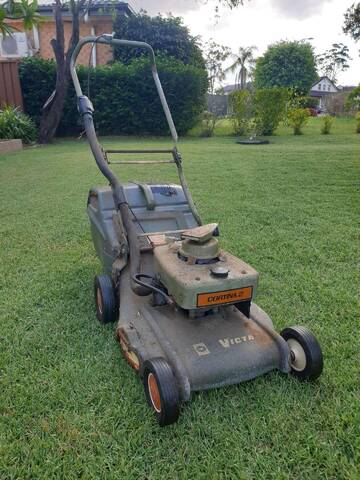
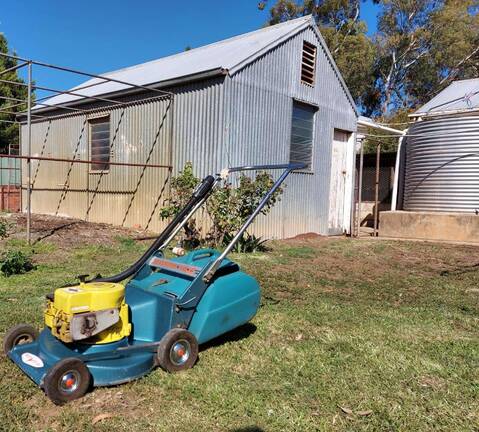
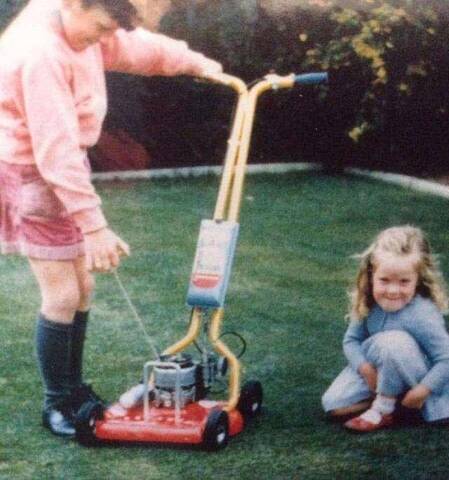
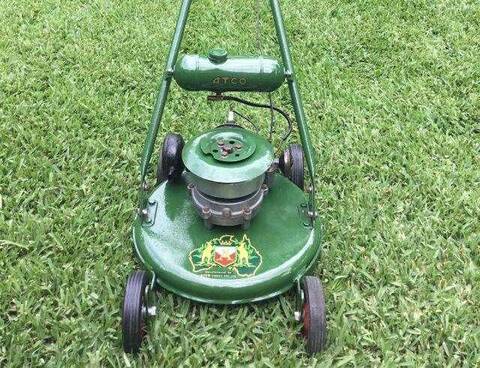
I have picked up another Scott Bonnar! This time a 450546 which im lead to believe is a lawnking. Only plan to give it a quick tidy up for now, and replace anything that is past its use by date.
When looking for parts, im assuming most exploded diagrams & part numbers for a sb45 17" are relatively the same?
Yes the machine you have is a Model 45 and everything bar the handle bar is pretty much the same as a regular Gull Winged Scotty.
This is a "Dual Aluminium plated chassis" which would date it around 1974, and thus it should have a 2 HP "60102" Briggs engine fitted to it while all the normal Scott Bonnar designated machines still had Kirby 2.5 and 3 HP engines fitted at this point in time. (HK25~H4 and HK30's)
The Lawn Kings were a store brand machine and were priced lower to sell thus they had lower powered engines fitted and cheaper handle bars fitted. This was the only differences between the two variants.
Cheers, BB.
I live a 24 Hour lifestyle, but every now and again I seem to fall asleep, well at least that's what my wife tells me.
This is correct as the first dual plates were brass units as the original brass units were only a one liner and then a serial number was introduced as a separate line, thus the second plate was introduced as an underscore. Now the only confusion that arose was why they did this in ally and not just get the new ally plate made up as a dual information unit from the start. I strongly feel that a lack of communication around the design in the plates was encountered and thus it only changed after stock of both top and underscore plates was exhausted as the company never ever wasted anything.
Cheers, BB.
I live a 24 Hour lifestyle, but every now and again I seem to fall asleep, well at least that's what my wife tells me.
Also when I purchased the SB, I noticed it was quite noisy in the engine/clutch housing area. Have since removed the clutch housing and it is still quite "rattely". Obviously these machines are old, but I kind of **expected** the NVH level's to be a little less.
Sadly this much mistreated machine has seen better days. That rear roller is paper thin and not worth repairing. I'd say most of the drive train toothed gears are well and truly worn out as well.
As far as the engine is concerned they never run well with out some sort of weight attached to the PTO shaft. This engine is a much later produced power plant than the mower itself.
Honestly Aiden I'm not sure if this one is worth salvaging because it's going to come at the cost of another machine having to die to give any signs of life to this one. I'd also feel that this chassis will have a few more stress fractures underneath the paint in the engine deck rails than just one, which in that case makes it the heart donor to another.
Sorry to be the bearer of bad news but that's just how it is sometimes unless you have good engineering services at no cost available to you.
As you well know there's good cars and there are bad ones out there and this is the bad one that's been traded in.
Cheers, BB.
I live a 24 Hour lifestyle, but every now and again I seem to fall asleep, well at least that's what my wife tells me.
Hi Guys, i know some will consider this sacrilege, but i had the tools and time to get this 17" going again. Nothing better than pulling it down and starting from scratch! I am pretty happy with the out come....!
Well you've gone all out on this one and I'm not sure what the sacrilege is apart from it not being restored back to Lawn King specs, actually boo hoo as far as I'm concerned as I've never liked the Lawn King handle bars from day one. Incidentally I've still got a couple of these examples laying around here which I want to move on, so if anyone's interested please write to me.
Now I will say that I've noticed you've managed to pick up another rear roller, replaced the shot reel with an 8 blade unit and replaced the pram bars with Gull Wing units, thus it now looks the part and is an absolute credit to you.
I must ask on behalf of future readers what did you do with the fatigued engine rails ?
Cheers, BB.
I live a 24 Hour lifestyle, but every now and again I seem to fall asleep, well at least that's what my wife tells me.
One major thing to take into consideration is rail distortion due to the welding process and how to eliminate it.
I must say though that with welding gussets into place introduces another issue and that's corrosion between the two metals that are now together "until death do them part".
Sadly capillary action will draw water and moisture in between the two pieces and the process of rust will do it's magical thing. I know that this will take quite a long time depending on how the mower is maintained over time, eg. keeping water away from it at all costs.
One thing I will say though and that is those rails will be far stronger now than any original twin rail chassis would've ever been originally.
Once again, nice result for a machine that was destined to go to scrap.
BTW where did you manage to score another rear roller and handle bar assembly from ? maybe around the Parafield Gardens area ?
Cheers, BB.
I live a 24 Hour lifestyle, but every now and again I seem to fall asleep, well at least that's what my wife tells me.
I've been researching this recently as I'm about to undertake similar repairs on a 17" machine. I have read up about using weld through primer on the faces of the metals that will overlap, and also paintable mastic sealer where there are gaps in the welds. Has anyone tried either of these?
Another thought I had which may eliminate the potential rust issue in overlapping metals, is to weld some flat bar to the bottom of the rails, perhaps leaving the ends open near the side panels and holes below the engine mounting nuts. It would be hard to paint/coat inside the rail nowt that it is effectively box section, but not impossible. Plus, it would tie the front and back sections of the rail together for a bit of extra rigidity. I'm no engineer though, so I'm sure there are drawbacks.
Probably not the most ideal scenario and it still wouldn't eliminate more stress fractures occurring as it's all about tying the existing engine mounting nuts to another stronger piece of metal as when the Jones Gusset repair method is employed one has to tack weld the nuts to the new piece of metal and thus strengthening the actual mounting points themselves and reducing excessive stress.
Cheers, BB.
I live a 24 Hour lifestyle, but every now and again I seem to fall asleep, well at least that's what my wife tells me.
BB, I'm not fully aware of what is going on, but if the concern is the 2 layers of metal together rusting internally, my fix would be to drill a few holes in the underside metal so the hole only goes through the bottom layer of steel and with the mower upside down fill the holes with fish oil and this will allow the fish oil to travel along between the 2 sheets of steel. It won't rust again.
For years this has been my only argument against the Jones Gusset repair method. But in saying this these mowers have had a 50 year lifespan so far and no one would expect them to be here for another 20. Heaven knows SB would've never in their wildest dreams thought that these mowers would be still in service 70 years down the track.
Anyway I see total merit in what you are saying Norm and what you suggest could be easily done without drilling any extra holes but just plugging the bolt holes and using those openings to allow the entry of the fish oil, alternatively extra holes could be added as you suggest prior to the welding process taking place, this would be beneficial especially if the gussets are of a longer length.
Cheers, BB.
I live a 24 Hour lifestyle, but every now and again I seem to fall asleep, well at least that's what my wife tells me.
Has anyone tried the gusset method using rivets along the front and back edges of the rail, and welds on the engine mounting nuts? Then maybe a mastic sealant between the rail and gusset? All the talk of distorting the frame has got me thinking of alternatives.