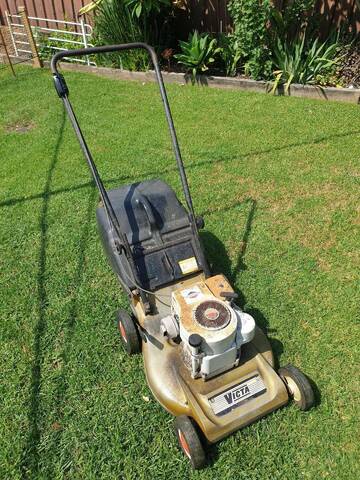
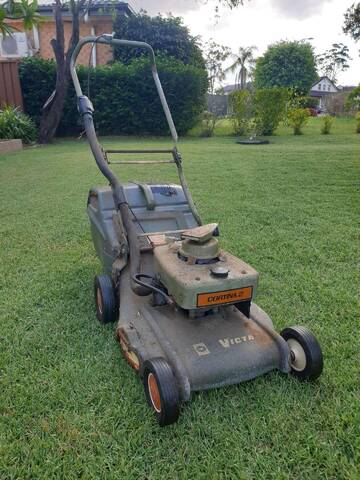
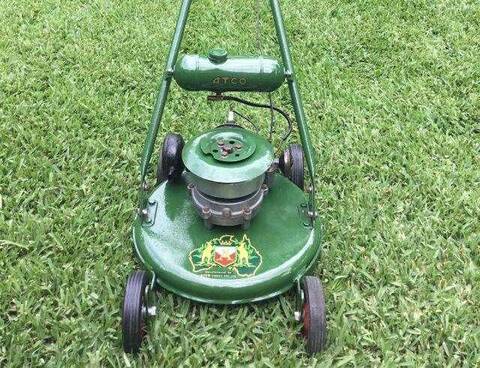
I ended up with these 2 Victas in a trailer load of mowers I picked up
One has a broken pull cord, not sure what is involved in fixing that yet,so no idea if it runs, the one in the pic runs well, but it has a carby problem in that it is difficult to control the revs. What is involved in cleaning these carbs and is this likely to be the problem and which model carby is it? Thanks Norm
Hi Norm, The pull chord is not to bad, there is a good YouTube clip showing how to do them. You will need to get a new o ring for the crankcase seal.
Your revs problem on the other mower is more than likely be hardened o rings on the inlet manifold and the starter housing. There cheap and easy to replace.
Are these worth restoring or are they just the beginning of the throw away mower market. The 2 stroke Victa is a really strong motor, can be a bit cantankerous with their starting, but at the end of the day does anybody really care about them
No there not worth restoring as even fixed up in fantastic condition you'd only get @ $200.The plus side is it has the Aussie made power-torque engine on it,and yes it will be an LM carby to late to have a G4.With your revs after checking all the other great advice above if you still have the same problem then I'd check the decompression valve.I've had them fail and cause that problem,but it most likely more what was said above.
Quote
but at the end of the day does anybody really care about them
No not really they were made in their thousands and in all different colours.In fact I have about 6 here at the moment and I'm going to sell.Once I've put blades and air filters in,but I only have one with the Aussie made engine.They are a bit older than the Chinese made engines.It's most likely made from 1995 to 1998.Where the carby in take is if you look on the block you will see a date stamp,it should be in a round circle.At least then you can put a date on it.
Geeze Blumby $200, I figured in good running condition they would have to be worth at least $30 and I would be over the moon if I got that. and I would probably throw in a can of starter fluid just so they will start first pull
I have the same model as the one above but in green, the Aussie engine you should be able to get to idle low and rev up nicely not like the newer ones. I have kept one as an example of the Powertorque engine plus an entirely made Australian mower, I like the small cowl on this model as it shows off the engine a bit.
Paul, got a bit grumpy with the second one today, thought I could rethread the cord without pulling the top off the crank, but with turning the motor over, thought this thing has no compression, so not worth wasting any more time on it, ripped the motor off, checked if it had spark, ok good,coil so I pulled that off, then was looking at it and bingo it hit me, the decomp!!! sucked on it and good compression, so now I will have to put it all back together again, doh Sometimes when you head down some path, you forget some of the basic things. I guess the best way to not make silly mistakes is not do anything
LMAO Norm... In the mower game, I've found that ya throw nothing out (unless totally stuffed) because you never know what you're going to come across down the track..
Regards, Paul
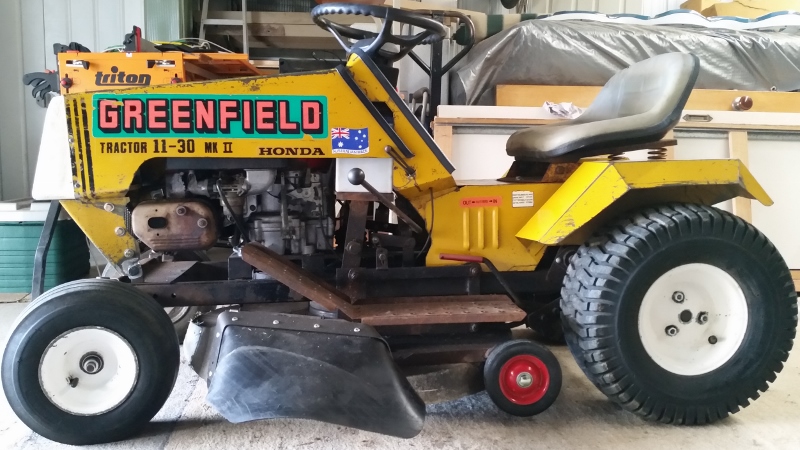
Such is life....... Nothing better than a "GreenField" just mowed..
SuperDooper your spot on there.I had some Briggs carby's and tanks I was going to through.A friend of mine was working on some for me and actually used them for those mowers.Even-though at the time I though I'd chuck them glad I didn't.So if it isn't completely buggered,store it.
The usual reason for these being sent to scrap, is that the base rusts out around the left side handle mount. Due to owners not hosing the underside out after use...
Apart from that issue, they're usually pretty fixable.
There's a starter how-to free download in Section 2 HERE.
Cheers, Gadge
"ODK Mods can explain it to you, but they can't understand it for you..."
"Crazy can be medicated, ignorance can be educated - but there is no cure for stupid..."
The hole in the jet can be blocked with gunk. The seal on the Prima cap can be rooted. And the diaphragm can be mangled. holes/cracks in the float. The needle can be excessively worn. And cracks and fractures in the body of the whole carby in general. Also, there is lettering (A, B, C) on the head of the puppet valve. Which the work shop manual talks about. Sometimes depending on which letter you have lined up with the groove in the seat where the valve sits it can affect the revving of the engine.
You have asked a most interesting question. I feel compelled to say something - as a non expert...
One of the features of the carby was less fewer parts. I feel they are a 'reliable' carby ... but not a 'performance' carby.
I have just updated the record on the G4 carby. I know it needs more work and input. I feel it was revolutionary ... but a compromise in terms of performance. Adjustments were limited.
So, the engine speed is preset at the factory. the tube at the rear of the carby that connects to engine block is the governor.
When the fly wheel speeds up, it creates an increased vacuum in the cap above the carb so the diaphragm lifts and closes the poppet valve just enough to reduce the fuel air mix and the engine reducing it back to the preset throttle position. When a load is imposed on the engine it slows the fly wheel down reducing the vacuum in the carby cap above the diaphragm. The spring in the cap above the diaphragm forces the diaphragm down to open the valve and allow a greater amount of fuel/air mix in and so the cycle continues.
some people get touchy about calling it a "vacuum" and stress that it's actually "negative pressure", but the victa manual describes it as a vacuum so whatever. At any rate, it self regulates. That's my understanding anyway. Someone will probably correct me. You can adjust the idle speed I'm told with these carboy's, there is a thread on it on the web page here, I'll find it and post the link if you like. but from my understanding it only works on the full crank design, as that allows you to access the button and clip while the engine is running. The power torque the connection is down in a tight spot and not practical to access while the engine is running.
So, the engine speed is preset at the factory. the tube at the rear of the carby that connects to engine block is the governor.
Hello Nolan I think you've got the theory right (for my modest understanding). But the rear tube would be for the decompressor, the front tube for the governor.
Quote
You can adjust the idle speed I'm told with these carbys
Yes. A later addition of the carby gave an idle speed adjuster. I might add, also, the governor springs changed to accommodate differing top speed requirements.
It's a clever carby, but not a particular efficient one. I guess.
Personally I like a slide or a butterfly on my carbs, then you can see what is going on. I have one of these LM carbs that is obviously running super rich from the amount of smoke it is putting out
[quote]So, the engine speed is preset at the factory. the tube at the rear of the carby that connects to engine block is the governor.
Hello Nolan I think you've got the theory right (for my modest understanding). But the rear tube would be for the decompressor, the front tube for the governor.
Sorry Cyber Jack, depends on which end you're calling front and back. The governor hose plugs into the "restrictor". I thinks that's what it's called on the diagram at the start of this thread. The decompressor gets plugged into the part of the carby which houses the puppet Valve head.
So, the engine speed is preset at the factory. the tube at the rear of the carby that connects to engine block is the governor.
Hello Nolan I think you've got the theory right (for my modest understanding). But the rear tube would be for the decompressor, the front tube for the governor.
Sorry Cyber Jack, depends on which end you're calling front and back. The governor hose plugs into the "restrictor". I thinks that's what it's called on the diagram at the start of this thread. The decompressor gets plugged into the part of the carby which houses the puppet Valve head.
But then maybe I've been hooking them up wrong
The 'restrictor' is actually a small separate part fitted inside the governor tube, and is only used on a few models with low [2700-3250rpm] governed speed.
It's more correct to say that the governor vacuum tube goes to the carby diaphragm cap, and the decompressor vacuum tube goes to the engine side of the carby body.
Cheers, Gadge
"ODK Mods can explain it to you, but they can't understand it for you..."
"Crazy can be medicated, ignorance can be educated - but there is no cure for stupid..."
Just as an update, today I used the Power Torque at the start of this topic, to cut a big yard full of kapock weed about 12 inches high, it handled it well but I would still like some throttle control when ploughing through this sort of stuff. As a result of this I am considering fitting a carby from a Villiers motor to one of these Power Torque motors so I can control the revs. Does anybody have any idea as to the strength of these motors compared to the earlier Victas bearing in mind these cranks are only supported on one side. I have a project in mind for one of these motors if they are strong enough
Still playing with and trying different things with these carbs and my question is regarding JB Weld and petrol. Does anybody know how resistant it is to petrol. I used JB Weld on the reserve tube on a motorcycle fuel tap many years ago and the owner has never complained that the reserve didn't work and he had to push the bike for miles so I assume it must be still holding ok. Any thoughts?


![[Linked Image]](https://www.outdoorking-forum.com.au/forum/uploads/usergals/2016/08/full-9841-29662-100_6524.jpg)

![[Linked Image]](https://www.outdoorking-forum.com.au/forum/uploads/usergals/2016/08/full-9138-29664-g4_carbie.jpg)
![[Linked Image]](https://www.outdoorking-forum.com.au/forum/uploads/usergals/2016/08/full-9138-29665-lm_carbie.jpg)
![[Linked Image]](https://www.outdoorking-forum.com.au/forum/uploads/usergals/2016/08/full-9138-29666-carbie1.jpg)
![[Linked Image]](https://www.outdoorking-forum.com.au/forum/uploads/usergals/2016/08/full-9138-29667-carbie.jpg)


 and I would probably throw in a can of starter fluid just so they will start first pull