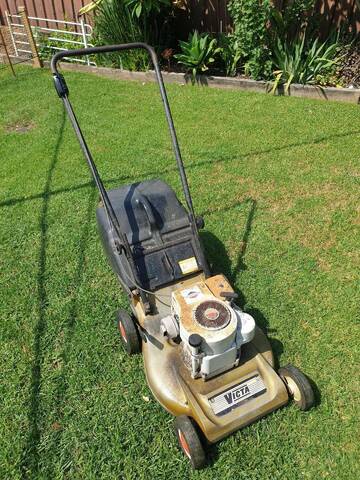
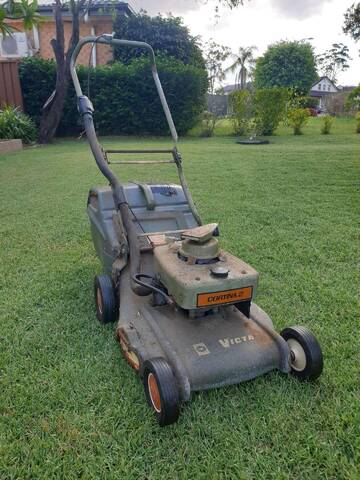
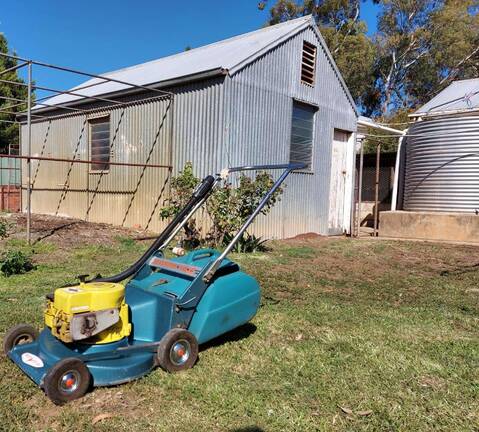
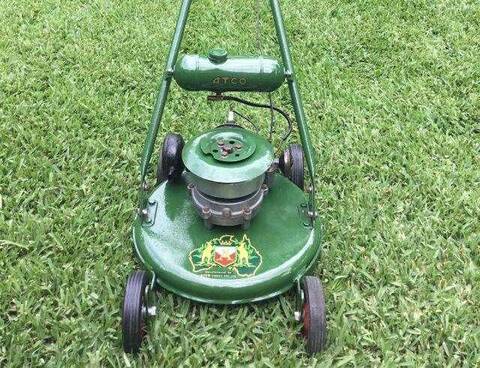
yes Kye I realise it's a rare mower brand (if not type). I'm not going to destroy it so don't worry. In the meantime I'm going to do a bit of learning with it. Sorry I didn't pick a 'common' type for you! If I can't do it justice I'll hand it off to someone who can.
The photo Gadge directed us to was instructive. I was wondering why the Eric Anderson had a much better lower half to the engine plate and it didn't change when I degreased it (unlike the previous, see the link in Gadge's post)- The lower half is a template sticker over the original plate.
I've taken some more photos (below) in different light and was able to see more letters from the original half. You can also see the peeling edge of the sticker around the right rivet with some remnant red ink/paint. I 'enhanced' the photo and can confirm it is similar to what was said before, no doubt a standard plate you've all seen before:
LAUSON (4?) STROKE PETROL ENGINE MADE IN AUSTRALIA UNDER LICENCE MODEL No SERIAL No Model No, Serial No, Instructions etc.
The sticker leads me to wonder what was written underneath? There's no change of oil company recommendation from Gadge's photo link, so unless the plate itself had a different info/company then likely someone has changed the oil specs/info. The sticker also appears to be there in Cyberjack's 1961 photo above. Or maybe they were just updating a set of older plates to a newer spec. Either way, the recommended oil is a SAE 40 instead of previously SAE 30 (unless the sticker had been removed sometime before Gadge's linked photo...).
I wonder if anybody ever followed those storage instructions, not to many I would think
I think sean does, even with a illegible instruction plate! His serial no is reasonably close to mine too, about 7000 earlier.
I haven't oiled because there's not much point with mine currently. Given the cylinder is on its side will slowly rotating the engine through satisfactorily distribute the oil to the 'high' (top) parts of the cylinder walls (if my cylinder moved)?
Patrick, you wouldn't believe it, but i have a spare Turner wheel, the only problem is, i'm so far away from you! I seem to have all the stuff you need, Kirby parts and wheels! sorry for the bad pic, not sure if it matches but its a Turner
In the meantime if mine's totally dead I was thinking of you- a Kirby w/o the ignition I think you said, well I think mine's still got the magneto at least... can't have thrown the piston without a spark! Have to try the spark and see.
And if both ours are cactus we might be shipping bits to sean yet...
I think your EA is still fixable Patrick, but its up to you what your going to do with it! My kirby had a stuffed crank case, it had chips and cracks in it, it was also missing the engine cover and fuel tank, it was just a broken flywheel, broken crankcase and the insides of a 4 stroke kirby on top of a Victa chassis.
Yep, I believe so. The Turner F61 base = Eric. Note the rear safety skirt. This base did not have a font safety skirt. [rear of mower is the LH side in photo]
p.s. It may be that the bladeholder was changed because it was too difficult to obtain Turner blades. (Turner stopped mower manufacturing in 1969). Eric would have had a long, active life after that.
It may be that the bladeholder was changed because it was too difficult to obtain Turner blades. (Turner stopped mower manufacturing in 1969). Eric would have had a long, active life after that.
Quite possibly. Although Bragg/Jetfast and some SupaSwift models continued to use the Turner blade/disc design, after Turner's exit.
The Turner type blades are still made though; GA Spares have them.
Note that these blades mount on top of the disc, not underneath as Eric now has.
It looks like Turner was an early adopter of the combination fluted cutting blade, which Victa only introduced in their 1968-9 season models, along with the P/No 9-210 blade disc [9-252 was the assembly with 9-263 combo blades].
Turner had filed a patent for a fluted cutting blade in 1961, which may have had some influence on that...
Cheers, Gadge
"ODK Mods can explain it to you, but they can't understand it for you..."
"Crazy can be medicated, ignorance can be educated - but there is no cure for stupid..."
I hadn't seen that patent. It's nice to know that Turner blades are still available too.
It appears to me that the issue of lift for catching went down two paths - one building lift into the bladeholder; another building lift into the blades. The combo blade clearly won out with Turner.
I think the fatter fluted Turner blade (Fan Type) came in with the Turner 'V' base - the first of the Big names to introduce a high-arch.
Gadge, I guess the fatter blades replaced the earlier, thinner flutes?
That's not a blade. This is a blade! ------------------------------------- Jack
It appears to me that the issue of lift for catching went down two paths - one building lift into the bladeholder; another building lift into the blades. The combo blade clearly won out with Turner.
Not quite two paths as in branching - more sequential developments. Combo blades came first, followed by fluted discs used with combo blades. Edit: Thanks to CyberJack, I now realise I need to qualify the statement above, to add "in the Australian market post-1950's".
Victa introduced their first fluted disc for the 1974-5 season [from your History Section brochure]: This exact type of disc is fairly rare now, as it was found that object strikes caused bent crankshafts. So a recall was done, and most were replaced. The replacements had a flute that was more of a 'swirl' than the 'wave' that the pictured disc has.
Quote
I think the fatter fluted Turner blade (Fan Type) came in with the Turner 'V' base - the first of the Big names to introduce a high-arch.
Gadge, I guess the fatter blades replaced the earlier, thinner flutes?
The 'Fan' type blades came in with the rear catcher Turners - one of those ads says that the 'Sapphire' model was fitted with them. So that pic doesn't show the actual Sapphire disc/blade set.
The side throw model blades had less aggressive flutes, and continued on with those.
Turner took out patents specific to their Sapphire and Valiant models, too. CJ, check your PM's for links to these.
Last edited by Gadge; 25/02/1607:32 AM. Reason: Add info, as indicated
Cheers, Gadge
"ODK Mods can explain it to you, but they can't understand it for you..."
"Crazy can be medicated, ignorance can be educated - but there is no cure for stupid..."
Not quite two paths as in branching - more sequential developments. Combo blades came first, followed by fluted discs used with combo blades.
G'day Gadge. Mate, I haven't written much on this yet. It is a topic of some interest. My argument will be that manufacturers started with blade holders first. This is clearly the case with the 1932 Rotoscytrhe, where the blades gave no lift at all.
In AUS mowers, the holders of interest are from the 1957 Pope and the-soon-to-be-discussed Collect-O-Matic. Supa-Swift, Turner and Rover, on the other hand, opted for the combo blade as the solution.
Interesting topic though. ------------------------------ Jack
Firstly many thanks to all for all your info, advice, knowledge, opinions and help. It's great!
interesting about the blades. Worthy of its own topic/thread perhaps? In the meantime I am following what you say (just), and I have to work out which base plate to get (if any) and which blades.
Some more newbie queries:
1) Firstly, any reason not to use an impact driver to get the base plate nut off? Just about off to TotalTools to make an 'investment' (read: male retail therapy )
2) I assume an original plate in good nick will be hard to find. I note a replacement on the GA spares site. I assume this is a non-original design (too many holes and looks different). It's not the same as the one I have fitted, is it? It would 'dilute' a restoration?
3) I also note the thinner, scalloped blades in the 1962 RPS photo. The GA Spares blades are straight, so non-original as well? More dilution?
4) "fluted'- you mean what I call 'fan blades', i.e. upturned back outer corner?
On that subject, the blades fitted to my Victa Utility w/ the B&S are I suspect also non original. They are straight fan blades that seem way to powerful... Like described elsewhere I mow around, working inwards with the grass ejection inwards to self rake/mulch. However the flap can be 'blown' open (no spring nor attachment for one as far as I can tell) by heavy grass, if that happens the clippings go rows across...so I tend to mow two rows in the middle before I reach there, that way any clippings end up in the middle, overlapping rather than crossing-over and causing more (albeit little) raking. (I assume these are windrows).
4) Windrowers (have to look up)... What about the one on the side of 'Eric' (as you've so named him). It's curved, the one in Jack's pic is square and has some sort of metal wire/bar support.
5) It may be a case of restoring to a good, repaired/working/workable condition then chasing complete originality. It may end up being a 'non-original' restoration rather than complete originality one. Would this be an offence against any laws/customs/sensibilities/deities?
Hi Patric, beauty is in the eye of the beholder, if you bring something back from the dead, give it a nice paint job, that is all that really matters. As for total correctness, that is only for certain people where every detail has to be correct, the rest of us mere mortals are just happy to look at a great restoration. Rattle gun is a must if you plan on this sort of work, so much easier.
1) Firstly, any reason not to use an impact driver to get the base plate nut off? Just about off to TotalTools to make an 'investment' (read: male retail therapy )
Every reason to use an air/electric impact wrench - it beats hammering on a spanner, which is what we used to have to do. For dismantling, anyway. I have a couple of air ratchet wrenches, too. Oh, and buy sets of Metric and AF 6-point impact rated sockets for it!
Quote
2) I assume an original plate in good nick will be hard to find. I note a replacement on the GA spares site. I assume this is a non-original design (too many holes and looks different). It's not the same as the one I have fitted, is it? It would 'dilute' a restoration?
The GA Spares one is fairly close, apart from the extra holes. In fact I'd say that's what is currently fitted to Eric.
THIS past thread has pics of an original Turner disc.
A cropped pic of one of the blades - which would be the correct type for your side-throw chassis. Unfortunately these [Turner P/No 50-07-18] ones are long unavailable; that poster seems to have had a bit of a NOS Turner parts trove...
Quote
3) I also note the thinner, scalloped blades in the 1962 RPS photo. The GA Spares blades are straight, so non-original as well? More dilution?
The GA Spares blades are an accurate repro of the Turner late type rear-catcher blade. A pic from CyberJack of a NOS set:
Quote
4) "fluted'- you mean what I call 'fan blades', i.e. upturned back outer corner?
Yes, that's it. It's the industry technical term. Most of these blades now have a 45deg flute, but one of the old Victa side throw blades [P/No 9-152] had a 180deg flute!
Quote
On that subject, the blades fitted to my Victa Utility w/ the B&S are I suspect also non original. They are straight fan blades that seem way to powerful... Like described elsewhere I mow around, working inwards with the grass ejection inwards to self rake/mulch. However the flap can be 'blown' open (no spring nor attachment for one as far as I can tell) by heavy grass, if that happens the clippings go rows across...so I tend to mow two rows in the middle before I reach there, that way any clippings end up in the middle, overlapping rather than crossing-over and causing more (albeit little) raking. (I assume these are windrows).
Yes, those are windrows. Most Victa Utes should run flat blades - there was an exception in the 1970's that used P/No 9-262 blades, with a low ~60deg flute, but those blades are NLA anyway.
Quote
4) Windrowers (have to look up)... What about the one on the side of 'Eric' (as you've so named him). It's curved, the one in Jack's pic is square and has some sort of metal wire/bar support.
That one looks like it might be made of plastic, too. It's more of a chute than a windrower, really. Eric's current one has the look of a 'tenant improvement'...
Quote
5) It may be a case of restoring to a good, repaired/working/workable condition then chasing complete originality. It may end up being a 'non-original' restoration rather than complete originality one. Would this be an offence against any laws/customs/sensibilities/deities?
The way I would go with a Turner is to get it to functional condition, for a start.
If you then decide to return it to completely original, you will at least have a 'runner' for the probably considerable time it will take, to acquire the OEM parts needed. And the haunting of swap meets, FleaBay and Dumbtree that will entail.
Cheers, Gadge
"ODK Mods can explain it to you, but they can't understand it for you..."
"Crazy can be medicated, ignorance can be educated - but there is no cure for stupid..."
Thanks all for the advice and opinions. It really helps me gauge haw far I could/should go and in what order.
Kye: Yes I realise it's the base that is more-or-less unique. If necessary I'll encase it in plastic and wall mount it to preserve it! My biggest worry is finding a structural crack in it I haven't seen yet.
NormK: Thanks again for the advice. Also the post about JB Weld elsewhere, there is some pitting to the base, filling may come in useful. I'll have a closer look this weekend.
Gadge: again thanks for taking the time to advise and inform. I got to Total Tools before I read your post, but yes experience has taught me so I got both AF and metric impact sockets- not only that but I got long ones so now I have those long sockets I've needed half a dozen times in the past
Only got a manual impact driver, it will do for this one-off, upgrade when necessary. Wish I'd known about them before I had my car suspension fixed, could've saved $$$ on the labour- couldn't get nuts/ bolts off.
There's a lot of other equipment I'll need to invest in along the way to do the job properly.
Small Engines Manual also arrived today so have some info on the engine servicing now.
Will let you know/post pics how it goes. At least the engine innards are likely to be interesting, in a damaged sort of way!
Spark available, free engine Spun the engine by hand w/ a paper clip in the end of the broken HT lead...Spark confirmed!
Also there seems to be a good amount of oil in the chamber and the engine spins freely without any feeling of friction so hopefully everythings preserved ok.
Blade carrier and engine off today. Impact driver worked exactly as it should, a first for me! My daughter's quite interested so whilst watching I managed to fit in a lesson on safety glasses (no glasses, no watch- even had a pair that fit her) so hopefully another good habit taught for life...she's a great listener and observer. And first thing she wanted to do was push 'her' trolley around...
Anyway, the blade carrier bolt was slightly unusual, 9/16" rather thsn the 1/2" I though I measured. The nuts on the engine mounting bolts were actually 14mm so may be non-original.
The Kirby/Lauson is mounted on three similar non-evenly spaced holes. They are approx 155mm, 165mm and 195mm apart.
Impressed how light the alloy base was for such a hefty piece of metal.
Will do measurements better later on, it was 2am and dark. Need to get an inch measuring tape I suspect!
Even more interesting, there's another three evenly spaced holes around the engine mounting ring so I wonder if another engine was also fitted to this base, e.g. a two stroke? Probably in one of Jack's photos I can't scroll back to at the moment.
Should've drained the oil, when I tipped the mower/engine over (to get at the bolts/nuts) afterwards I spun the engine over intending to look in through the spark plug hole and it pumped oil out the breather, which backflowed all down through the mostly degreased engine...
Also have some cuts in my fingers from the spark test the other day, must've been some razor sharp metal edge on the broken starter wheel.
A closer look at the logo also showed either it's been repainted or they did a bodgy job in the first place. Might look for some original paint underneath at some point.
Progress and pics Progress has been a bit slow in amongst other things. However some has been done and I did promise some pics. If anyone sees anything amiss, non-original, irregular or unusual please let me know.
First thing was the nuts/bolts don't see to exactly fit either AF or metric perfectly. Any ideas why? Maybe 19/32" instead of 9/16" or some such strange value?
Male retail therapy and engine removal (last week- end of Feb) If I have my way more will yet be required
which did the job (9/16" socket fitted best) getting the following off...
leaving the following exposed...
Which allowed me to remove the engine. I think 14mm sockets/spanners worked and I'm not sure they are entirely original as at least one had a (thin) washer missing.
This week- (Mar 1st week) Handle nuts
This week I needed to remove the handle, filter and (importantly) original throttle + cable. I also removed the chute cover to protect it from damage. When I went to remove the handle bolts I found this wonderful improvisation or engineering/industrial design. I can only assume it was the "Nyloc" before "Nyloc' was invented. Someone's had a good 'go' at one in the past... Amazing!!! Am I right or can someone correct me?
Eric gets a sea-change / career change / restart in life Firstly, SORRY KYE!!!
But think of it not as a loss, but perhaps a repurposing... ...or new lease on life ...or a sabbatical... ...or temporary job-sharing arrangement.
Which was put to immediate use; my daughter took immediate possession for some garden work... ...which somehow seems a worthwhile and suitable replacement task. You can see no mods had to be made and by chance the colours of the basket and string even match the original, more or less. It's somehow fitting. Given Eric is probably around 55 years old I think it's wonderful he is still sturdy enough to be put to good use and in the garden too. Some new wheels and they'd be no problems as a cart whatsoever. Let's see how many of today's 'appliances', with their thin pressed steel covered in even thinner paint with no rust-proofing are around in 55 years.
In the meantime, Eric gets to sleep in his own garden shed.
Cheers,
Last edited by Pitrack_1; 07/03/1612:59 PM. Reason: minor typos, extra info


![[Linked Image from i1222.photobucket.com]](http://i1222.photobucket.com/albums/dd490/pitrack_1/Eric%20Anderson%20Mower/engine_label_2_zpsuthc73re.jpg)
![[Linked Image from i1222.photobucket.com]](http://i1222.photobucket.com/albums/dd490/pitrack_1/Eric%20Anderson%20Mower/id_plate_info_zpskwdfbz5d.jpg)


![[Linked Image]](https://www.outdoorking-forum.com.au/forum/uploads/usergals/2016/02/full-9734-27157-12735685_10207092734851426_1684880943_n.jpg)

![[Linked Image]](https://www.outdoorking-forum.com.au/forum/uploads/usergals/2016/02/full-7392-27173-turner_base_f61.jpg)

![[Linked Image]](https://www.outdoorking-forum.com.au/forum/uploads/usergals/2016/02/full-7392-27176-turner_03.jpg)
![[Linked Image]](https://www.outdoorking-forum.com.au/forum/uploads/usergals/2016/02/full-7392-27177-turner_02.jpg)


![[Linked Image]](https://www.outdoorking-forum.com.au/forum/uploads/usergals/2016/02/full-5630-27183-victa_fluted_disc_1974.png)

 )
)![[Linked Image]](https://www.outdoorking-forum.com.au/forum/uploads/usergals/2016/02/full-5630-27195-turnerblade2.jpg)
![[Linked Image]](https://www.outdoorking-forum.com.au/forum/uploads/usergals/2015/10/full-7392-24677-turner_fuel_blade.jpg)

![[Linked Image from i1222.photobucket.com]](http://i1222.photobucket.com/albums/dd490/pitrack_1/Eric%20Anderson%20Mower/impact_sockets_and_wrench_zpsxi3n9nap.jpg)
![[Linked Image from i1222.photobucket.com]](http://i1222.photobucket.com/albums/dd490/pitrack_1/Eric%20Anderson%20Mower/blade-plate_bolt_washer_zpsyvsnnfbm.jpg)
![[Linked Image from i1222.photobucket.com]](http://i1222.photobucket.com/albums/dd490/pitrack_1/Eric%20Anderson%20Mower/Engine_underside_plate-boss_zps2xy04cpr.jpg)
![[Linked Image from i1222.photobucket.com]](http://i1222.photobucket.com/albums/dd490/pitrack_1/Eric%20Anderson%20Mower/handle_nuts_zpsspmnaied.jpg)

![[Linked Image from i1222.photobucket.com]](http://i1222.photobucket.com/albums/dd490/pitrack_1/Eric%20Anderson%20Mower/Eric_repurposed_1_med_zpsvnjl4hnc.jpg)
![[Linked Image from i1222.photobucket.com]](http://i1222.photobucket.com/albums/dd490/pitrack_1/Eric%20Anderson%20Mower/Eric_repurposed_2_med_zpsn88lwkca.jpg)