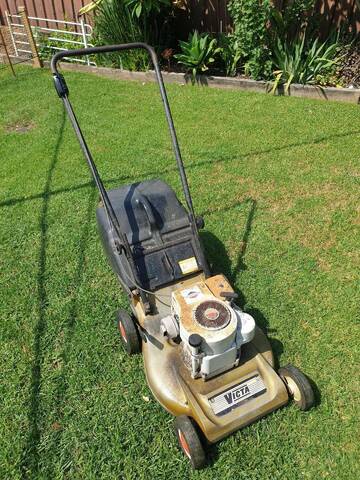
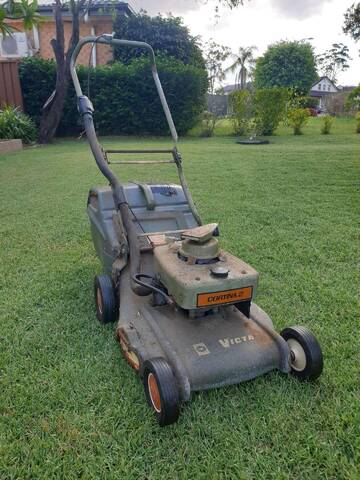
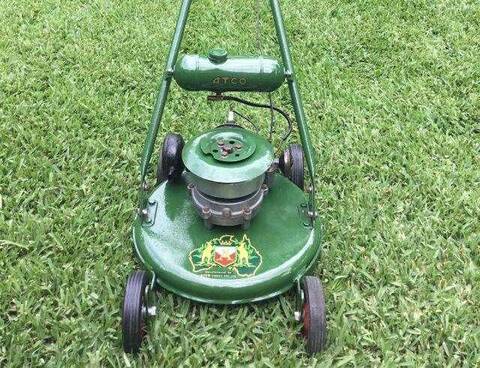
My mower's handle bar is broken into 2 pieces and just wandering if anyone has tried fixing this using Bernzomatic profane torch to reconnect them. See attached photo.
ok thanks. I'll give it a try. I actually inserted a piece of pipe before trying to use a rivet but the handle still move when i used it and after a while the rivet comes off whilst in the middle of use. I was just thinking that it may not weld properly when i used the propane torch. To be safe, I will perhaps remove the top frame from the body as the heat could travel into the fuel tank. Glad that you mentioned the rod to use as i wasn't sure which one.
Not sure what are the profane accessories. I only have the torch itself but i need to get an eye protection glasses and a gloves too i suppose.
See attached Propane Torch. Beside the torch is the tube i inserted onto the fram. It's about 2cm in diameter and appears to have a thicker gauge than the handle bar.
Hi Shannon, I don't know how effective those propane torches are for welding, I have never tried welding with one, I have always just used them as a heating torch. I don't think they would weld but I'm always open to seeing what they can do. I don't think they even get hot enough to melt silver solder effectively
Oh i see. I have some doubt too on whether this will do the job and so the reason why i made this post to see if anyone out there has done it with this propane torch. If you happen to know someone whom you can recommend to do this welding job, please let me know.
The only equipment i have is the propane torch. Perhaps i should give it a try and see how it goes using the brazing rod that Tyler suggested. I'm based in Sydney.
If this propane torch will get the metal hot enough it should braze another way is to get 2 car batteries (12 volt) and wire them up for 24 volt and use an arc welding rod but you would need a welding helmet.
I've never heard of welding with Propaine but have heard of cutting 1 inch plate with Propane and Oxy.
Propane will solder and a high intensity torch will Braze.
Hi Tyler, what brazing rods were you talking about, I'm always looking for other ways of welding things. I have oxy but the bottles I have are "borrowed" so not easy to get refilled, so I keep the use of them to an absolute minimum
I distinctly remember welding with something like this, thin like wire and I started off with an oxidising flame on the oxy and was just blowing it away. Even a neutral was cooking it. I have no idea what I was using though - it was left over rods in a big pack
But again, I think try for lowest silver level you can reliably melt with the propane
G’day folks, this could be done using a propane torch but you’d need a fair bit of luck on your side, probably not going to be successful as a first go. The main reason is that these propane torches just don’t have the oomph.
I’d suggest either taking it to a job shop and carrying some cash in your pocket, looking at your local tip shop for a wrecked mower of the same type with an intact handle or looking at gumtree etc for a similar thing, this is much more likely to be successful.
I’ve joined lots of metal together and had heaps of failures along the way so, if you do want to try, here are my suggestions.
Firstly this won’t be welding, if you get things exactly right it will be brazing. Welding is when the base material is melted and joined to another component by fusing it at the margin. A hand held propane torch won’t get things hot enough to melt steel.
To braze effectively you’re going to need a few vital things to be spot on. If any of these are not right it’ll just create a mess and can cause serious injuries. You’ll be dealing with molten metal, poisonous gasses and intense heat.
For brazing to work well everything in and immediately surrounding the join needs to be back to bare metal and smoothed out. Rust, paint, dents etc cause failures. Cleaning the inside of a tube can be problematic, I’ve done it with emery paper on a dowel in the past.
After surface prep it needs to be completely dust free and wiped down with a solvent to give you the best chance of success.
A brazed joint works through capillary action drawing the molten filler material into the very small space between the parts to be joined. The two parts must be close fitting but they also need to be able to be moved over one another without galling. The very small space is what allows the joint to form. Too tight and it won’t allow the filler to be drawn in, too loose and the joint won’t form with any strength.
The filler material forms an extremely thin alloy on the surface layer with the base material, filling the very slight void in the process.
You’ll need flux suitable for the base metal and filler selected. The flux does several jobs that there’s no time for me to explain right now.
So, with everything scrupulously clean, close fitting and the flux applied you then heat the entire area of the joint to a uniform orange heat. This is aided by putting fire bricks around it to retain the heat. An orange heat is what happens after the red heat phase. You’d then apply your filler rod and, if all the prep work is right, it will be drawn into the join by capillary action.
Brazing will not result in a strong joint if you try more than once to heat it and apply the brazing filler. The filler will just be evacuated from the joint and leave voids. So it’s a one shot chance, if you don’t get it spot on the first attempt you will need to strip back the joint, clean everything and try again.
Hi Max, the bottles I have are BOC ones and I doubt they would just refill them. I'm just not game enough or got enough front to go there and try. I don't need oxy that much but boy when you need it you really need it because nothing else can give you that concentrated heat point.
Absolutely, when you need concentrated heat there’s nothing like oxy/acetylene
I have “supagas” cylinders for oxygen, acetylene and a couple of Mig mixes that I use regularly. I did a bit of a tally up before making the switch. I might go 6 months without using them and then go through a couple of cylinders in a month. It was cheaper for me to buy mid size cylinders from supagas and use their swap service than pay the rental plus the refill cost for these gasses. The cylinder size is small enough that I can easily put them in the back of a ute myself without lifting equipment.
I also have an account which allows me to either go in and pick up a cylinder of a specific mix I might need or have it dropped off to me the next day after a Phone call. I pay cylinder rental for LPG as that’s the least expensive way to get the volume I need for my workshop and they drop off and pick up the empty large cylinders that I find very awkward to move, even with a trolley.
I found that BOC wasn’t really set up for more irregular use. Their model catered for the business that used the gas more or less continuously. The different suppliers have quite different pricing models each one catering for different use patterns. It’s worth shopping around, I deal with three different mobs because each does one thing in a way that works for me.
I might have to try supagas for a refill / exchange.
I'm not sure Norm if they would refill the BOC bottles ,I know with Propane they take any old bottle and exchange it for a full one ,I usually just buy second hand oxy acetylene bottles that are usable and then when they are empty throw them out.
There is a seller saying his bottles are not stamped so no problem refilling them but it does make you wonder if someone ground off the BOC on the bottle would they exchange them ,I think they would take an unmarked bottle.
Hi Max, Where do you throw the old bottles out. I have an 8inch post hole auger, I dig a 4 foot hole and just dump them in there. Somebody might get a shock one day if they start digging around here
That is funny Norm ,burying bottles in the ground ,I hope you didn't bury any alloy bottles as that's a lot for scrap alloy these days.
If I threw out a complete bottle I would just dump it in a free scrap metal bin ,lots of places have free scrap metal drop off , tips ,car wreckers ,and some scrap metal yards have a big bin out the front .These days I have seen some signs on the bins that say no pressurized bottles to be dumped in scrap bins .
All the last bottles I dumped ,I would unscrew the brass fitting with stilsons and cut one end off with the angle grinder then sell the steel for scrap.
Just cut the top off and it's no longer CIG BOC etc..
Scrap yards just don't like closed bottles once you cut the end off they could not care less.
I know of a few places here that you could dump the bottle in a free metal bin but not sure where in your area but if you cut the top off the bottle the scrap yard you go to will pay for the scrap but don't take the end cap that you have cut off at the same time as the bottle or throw the end cap in the scrap bin at the tip.
It looks like you won't be getting any more welding rods from FJs Discount Tools Norm as they have closed down.
Hi Max, How did you know I had been getting my welding rods from FJ's, I knew they were closing down but didn't have time to get there to restock my rods. Will have to find another supplier. No I have only buried the steel bottles. Doubt I would be too comfortable cutting the top off an acetylene bottle but I guess that is no different than cutting up car gas tanks and I have done a few of those over the years
I got my rods from FJ's and I remember you saying Norm that's where your rods came from.
Yes the safest way is to fill the empty bottle with water before cutting but I don't do that most of the time when cutting up gas tanks etc ,I fill the empty bottle with compressed air a few times and empty and repeat until the air coming out of the tank can not be ignited with a lighter .
The scrap yard here will take a complete gas tank so you don't have to cut them up.
I guess the bottles will eventually rust away in the ground just might take 100 years.
I did see an alloy bottle after it exploded and it took out a lawn mower .
It’s not impossible, I’ve done similar brazing jobs when I’ve had no options.
I might repeat myself but here are my suggestions
make sure all the mating surfaces are completely back to bare metal (no corrosion, plating, paint etc)
that they are clean of dust and any other deposits (a drop of oil will cause failure of the joint)
Ensure the surfaces mate uniformly to one another (I.e. that there are no burrs on edges or depressions in surfaces)
Ensure a good fit, the surfaces must be snug but with sufficient movement to generate the capillary action required for brazing to occur. With tubing this is loose enough to allow the pipes to slide by hand but tight enough not to wobble.
Most of the work is in the preparation. The temptation is to rush to the heating stage however, those that do rarely have success. A little more time and effort with cleaning and ensuring the correct fit will save a lot of frustration later.
Make sure you have the correct filler rod for your job and the right flux.
Construct a method of containing and concentrating the heat around the parts. Fire bricks are best but failing that use some form of fired masonry. I’ve used terracotta tiles, old red bricks, clay pavers and on one occasion, a large broken terracotta pot. Don’t use stones or anything made of concrete, it can explode and injure you badly.
Get the steel to a dull orange (beyond red heat but not bright orange) and then apply the rod to the steel and allow it to melt and flow into the joint.
Don’t try using the torch to melt the rod, that will just make a mess and even if some joining does occur it will fail under any load.


 .
.