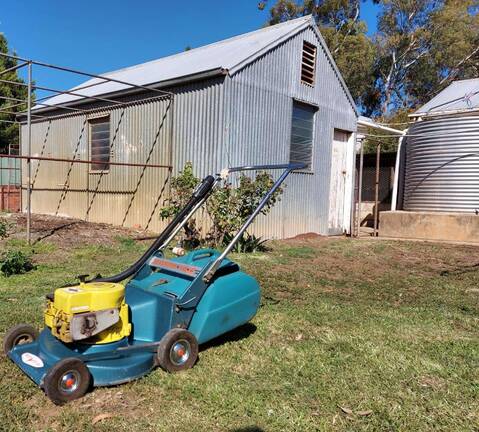
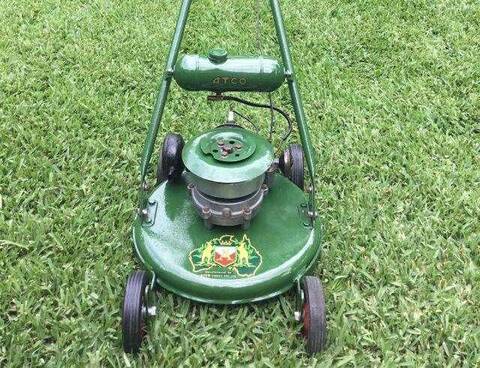
Can anyone enlighten me about the history of Rover and Tampico Pty Ltd at 43 Snook Street, Contarf? I had always thought of the Eagle Farm plant as the main Rover HQ, but I recently came across a blue era Rover stamped "Manufactured by Tampico Pty Ltd, Clontarf". Further research online shows there was also a ride on mower called the Rover Tampico, which must have had something to do with Tampico Pty. Ltd, judging by the name. This suggests they were making lawnmower frames as well as other Rover machines. This part of Rover history is a complete mystery to me. Can anyone shed some light on this part of Rover history?
A Google search shows that this location was once owned by Tampico Tools up to about 2012. It was later sold and became a tyre and suspension shop. Seems to be an empty building today.
Last edited by vint_mow; 27/04/2609:55 AM. Reason: Photo added
Photo of Rover mower frame shows it is a slightly different style to the usual blue-coloured Rovers from the 1970s. The wheels are also different. Otherwise it has the typical Rover badges and stickers. I'd guess the 220 series engine would be original?
When I look up the History I get the following on Google below.
While Eagle Farm was indeed the heart of Rover Mowers Australia, the Clontarf site at 43 Snook Street served as a critical satellite manufacturing hub, specifically during the "blue era" (roughly the late 1980s to the 2000s).
The Tampico & Rover Connection Tampico Pty Ltd was essentially a specialist engineering and fabrication arm. Rather than being a separate competitor, they operated as a dedicated contract manufacturer for Rover. Here is the breakdown of why that Clontarf stamp exists:
Chassis & Deck Fabrication: While Eagle Farm handled the assembly, painting, and distribution, Tampico was responsible for the "heavy lifting" of the steelwork. They manufactured the pressed-steel decks and the tubular steel frames for the ride-on mowers.
The "Rover Tampico" Model: This model wasn't just named after the company; it was a tribute to the partnership. In that time frame, Rover released the "Tampico" as a mid-range ride-on mower. It was designed to be a simpler, more rugged alternative to the high-spec "Rancher" models. Because Tampico Pty Ltd did the primary fabrication for this specific line, the name was adopted for the model itself.
Blue Era Significance: The "Blue Era" Rovers (moving away from the classic red/white or yellow/red schemes) marked a period where Rover was trying to modernize its manufacturing process. Outsourcing the fabrication to Tampico in Clontarf allowed them to scale up production without overcrowding the Eagle Farm plant.
Interesting bit of history there. I sold my two very odd-looking early Rover mowers to concentrate more on the blue era ones. The design phase of Rover seemed to reach its peak in the 1980s and was further refined into the 1990s, with a fairly standard 18" red mower frame with chrome handlebars. This basic design changed very little in over two decades, although they did switch from aluminium alloy bases to steel bases in more recent times, which was a shame. You got a stronger base in the short-term but paid for it with rust in the long term. The plastic powdercoat paint looks great when new, but all it takes is one puncture and the water gets in. It spreads in no time and before you know it you are poking your fingers through the base. Powdercoating the base was a bad mistake in my opinion. The old aluminium alloy would go powdery with age and exposure and was prone to cracking if mowing amongst rocks and sticks, but you find lots of aluminium bases still around after 30-60 years or more, but not many steel bases. I am always coming across them at tips. The powdercoat still looks good on top, but tip the mower over and you can often poke your fingers through the rusted areas underneath. Just powdercoat on the surface and nothing beneath it.
It's amazing how long those steel bases last if people look after them Vm ,when I was a kid I'd see people after mowing if they cut wet grass they'd get a stick afterwards and scrape the wet grass out , even in the fifties it mentioned in the Operator’s Manual or an Owner's Manual that they recommended waiting until the grass was dry before cutting.
Yes, find them all the time at the dump totally packed up underneath with grass. Some still have the mulch plug installed. I am sure some people can't get their mower to go because it is packed up so solid underneath with caked on grass that the blades won't turn. I also see lots of people mowing in the rain, back when we were getting rain. Just lately it has turned so dry that there is no lawn there to mow.
Yes I'm surprised how many people I see mowing in the rain Vm
The strangest mowers I ever got from a tip shop for $10 was a mower that looked new but was seized and when I looked at the blade it had a gum-nut stuck on the end of the blade and someone at a tip shop selling me a cheap Flymo mower because they said the wheels were missing.
Never had a Flymo as far as I can remember. I did come across a mower at the tip one time that must have mowed over some bailing twine which had wrapped around the bearing on the shaft so tight that it had actually cut into the seal and was preventing the motor from turning. I had to remove the seal and replace it to get rid of all the twine. Its amazing how tight that stuff can get when it wraps itself around a few dozen times. I've come across dead snakes and live frogs in cowels at times. I've had sticks jam up the blades underneath and they can be very difficult to pull out. It's not always something mechanical that stops a mower turning. You can be foiled by something as simple as a gum-nut. And then the wheels fell off...