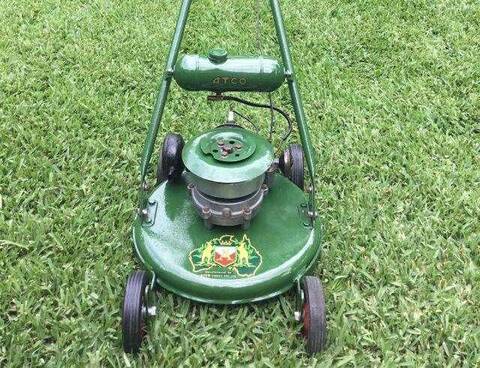
Hi Rideon, a few issues I see axle is too high on the kingpins and axle diameter and length would be different so probably not able to use those, The $99 kits probably better value because you have nowhere to mount the handelbar brake lever so the rear type master cylinder could be mounted somehow. Lots of options I still think it would be easier to make yo the new stub axles to suit your king pins setup and that way you can set the stub axle at the right height to suit your wheels and mower deck height. Pity you are so far away
I don't see the wheels being an issue, fairly simple to make a new stub axle assembly with a mount for the calliper out of 40x10 flat and maybe lengthen the axle to allow the wheel to move out a bit wider for calliper clearance. Fairly simple then all it needs is for a disc to be bolted somehow to the existing wheel. All simple to do if you had access to the mower
Hi Norm,
Yes it's simple if you have the tools and can do this at home but would be an expensive job to get done and time consuming.
Any back yard welder should be able to modify the I beam front for more movement ,just needs a little cutting and welding, you could just add RHS to the lower half to strengthen the I beam after the metal from the top is removed.
It is difficult to see from this photo, but the right front wheel is suspended about 30mm above the pavement [img]https://photos.app.goo.gl/WbYHEuAfGkitaFLi6[/img] While the mower is fairly horizontal in this photo, the ground falls away near the front right wheel. There does not appear to be any travel in wheel height of the suspended wheel. Placing about 5kgs over the front right wheel causes it to go to ground and the left rear wheel then lifts by the same 30mm. In other words, no suspension and a rigid frame.
This video shows the problem (ie, most weight being over front wheels) with braking going downhill, even on a Zero Turn mower . They appear to use a front brake that is neither drum or disk?
the right front wheel is suspended about 30mm above the pavement While the mower is fairly horizontal in this photo, the ground falls away near the front right wheel. There does not appear to be any travel in wheel height of the suspended wheel. Placing about 5kgs over the front right wheel causes it to go to ground and the left rear wheel then lifts by the same 30mm. In other words, no suspension and a rigid frame.
I can't find any information online that suggests this mower has a pivoting front axle and can't find any parts manuals but from what I can see in the images with the centre front mounting bolt it looks like it should pivot ,I would loosen the bolt and see if the front axle will move .
I have looked at the front end geometry and taken the following photo Front end geometry I may well have labelled the components incorrectly, but I needed them in order to be able to discuss.
From what I can see, I think there is only a slight height adjustment possible (to level front end), between frame and subframe, and no way for it to pivot. The bolt that you saw in previous photo (looking from the front of mower) attaches the subframe (or crossmember) to the frame.
I forgot to label it, but there is a bracket that hangs down about 50mm with a bolt in it, but currently doesn't appear to serve any purpose. There is one on each side so I assume they could be used to mount something? In the photo, it is partly obscured by the nut on the left end of steering rack.
I would undo the lock nut ,then undo the bolt but leave just enough thread on the other side to stop the front axle bottoming out where I drew 2 blue lines ,you could take the bolts out completely but them the paint will be damaged when the axle is on full tilt so a little bit of the thread on the bolt against the axle will stop the paint on the axle getting damaged.Then tighten the lock nut to hold the bolt in place and do the same to the other side of the axle (left & right side bolts)
The yellow arrow points to the U shaped metal that forms part of the mower frame.
Even with the adjusting bolt totally removed, I think there would be minimal travel in the cross member (or what I think you are referring to as the axle?). While the cross member would try to drop on one side it would be prevented by rising on the other side and hitting against the U shaped frame. There is only a few mm gap when mower is on a level surface. I might have it wrong though?
I thought if you adjusted the bolts so there was clearance on both sides of what you named the frame then there would be some room on both sides so the cross member could move .
It sounds like even if you can get the front to move it still wont move enough unless the cross member was modified.
Sometimes if I need to take a ride on mower over very uneven ground I just put down a 19 mm sheet of plywood and take the mower over that like a bridge ,if the mower is only slipping in one spot it might be worth trying some plywood.
Thank you for the suggestions. I have been thinking of raising the offending section of the path by about 30mm with an appropriate coating.
In the meantime, I am still thinking about all options for front wheel braking, as I think this is still the most effective braking. This is a bit 'left field' but I was wondering about a manually operated brake that applied pressure to the ground between the front wheels. I think it would look something like this Manual brake There seems plenty of scope to mount it. Actual braking mechanism could be something like Brake Biggest problem I see is a mechanism to apply pressure to brake to force it firmly to ground.
a manually operated brake that applied pressure to the ground between the front wheels.
It won't stop a mower weighing more than 200 kg very effectively
It's essential for heavier equipment to have advanced braking systems specifically designed for their weight and intended use..
When you add brakes to the front wheels of a mower that's not designed for them you're assuming the rest of the components can handle the extra load placed on them.
Steering components of the mower may not be designed to handle the increased forces from the enhanced braking system. This could lead to premature wear or failure of these components.
In my opinion the easiest way to fix the skidding in that one spot is to flatten out the path or put down some plywood every time you use the mower.
I'm not saying that installing front brakes won't work, but you need to understand how changing one component will affect another that wasn't set up to handle the extra load
Increased Stress on Steering Components: The addition of quad bike brakes may lead to increased braking torque being transmitted to the steering components (front end components). This can accelerate wear.