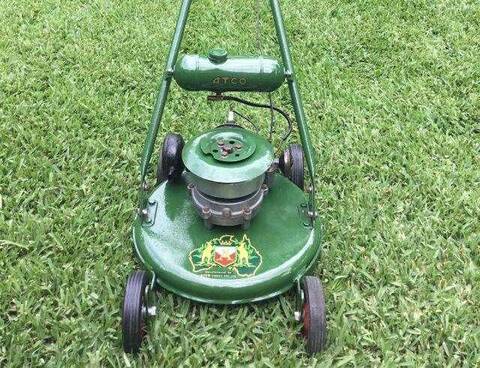
Hi, I have purchased a Greens Master Lightweight Motor Mower with a 98cc Villiers 2 stroke motor? Is there a manual for the mower and motor available? Also are where can you get parts in Aust for a Villiers motor? Hope you can help Cheers Wonka
Yes we do have a manual for the two stroke 98cc Villiers motor and you have access to the parts list and manuals area. If you you require more information upload just post on the forum and we will do our best to get it for you.
Regards,
Bruce
Please do not PM me asking for support. Post on the forums as it helps all members not just the individual.
Still working on the Greens Cylinder mower and now looking for a spark plug for the Villiers motor. It can be a Champion 8 Com or KLG ML 30, the thread size is 18mm. can anyone point me in the right direction as to why I can but one in Australia
Still working on my Greens Master Lightweight and am now starting to assemble the cutting blade into the housings with the bearings. Just want to make sure I get it correct as I did not take any in-depth photos of that assembly and was hoping someone would have a diagram of that particular part.
I have another question about my Greens Cylinder Mower. Does anyone know what the thread is on the drum and cutting blade. I have been to many bolts places and they cannot work it out. I was told it was a BSF thread, but not right.
Hi Wilco, I have no idea but if Villiers had anything to do with it, Villiers at the time way back decided they would cut their own threads which are referred to as Villiers threads
Does anyone know what the thread is on the drum and cutting blade. I have been to many bolts places and they cannot work it out. I was told it was a BSF thread, but not right.
G'day Willo and Norm Well, nuts and bolts places you have visited cannot be very good.
The Greens would not have used Villiers proprietary threads at this time. In fact, the question regards chassis threads, not Villiers proprietary threads.
At this time, Greens were probably using a combo of threads.
In my experience, English used a combo of BSF, Whitworth, and SAE threads at this time.
In the modern era, the solution will be BSF, SAE UNF, or SAE UNC. The exception will be 1/2 inch threads which might be Whitworth or UNC.
This is not rocket science, but many 'bolt places' have no idea.
Unfortunately, I have never secured a parts list for a Greens Master.
If this issue causes your grief, PM me and we will work through this. We are here to help each other.
Hi Jack, Believe it or not, Royal Enfield were still using a half inch Villiers thread on their crankshaft nut up until 2008 when they came out with a completely redesigned motor
Here is the latest on the problems with the threads on the Greens. I have a 3/8 BSF bolt and the one original nut I have screws on with no problems. I then take a new BSF nut and also screw it on the bolt, no problems.
I take the original nut and screw it on the drum shaft with no problems. I then take the new BSF nut and try and screw that on the drum shaft and it binds up and will not screw on.
I hope that all makes sense???
I am planning to buy a 3/8 BSF die nut and see it that cleans up the threads.
Believe it or not, Royal Enfield were still using a half inch Villiers thread on their crankshaft nut up until 2008 when they came out with a completely redesigned motor
G'day Norm I understand what you mean now. These are now called cycle threads.
I guess because one of villiers' earliest products were the freewheel clutches used on bikes.
These were high TPI threads because they used thin nuts as part of the design.
Cycle threads are still used today. [see interesting story attached].
Hi Jack, just for kicks and giggles I will put this up regarding Villiers from an article "The Nuts and Bolts of the Matter" . It is lengthy but I will just put up a bit about Villiers Villiers had a partiality for 20TPI constant pitch threading. This means that regardless of screw diameter they threaded it 20TPI. This is the same idea as the 26TPI used in British Standard Cycle thread but Villiers decided on 20TPI not the 26 of BSC. It was acceptable engineering practice of the day and in fact examples of it can be found in odd places on various British bikes. In practice this is only an issue where 5/16th x 20 thread was used as there are easily available alternatives for all the other sizes. Either BSW or UNC covers 1/4 x 20, BSF covers 3/8 x 20 and both 7/16 and 1/2 x 20 are standard UNF sizes. The only one you can't match is the 5/16 x 20. Villiers did not use it a lot so it doesn't often cause a problem.
Hi Norm! Brilliant ... very interesting because it rings so true!
20TPI and 26TPI are the cycle threads I know. They remain constant over diameters.
Here, we mainly deal with BSC [British Standard Cycle] at 26TPI.
You have explained Villiers' proclivity to 20TPI. I never knew that!
I would like to make this point to readers ... The Imperial System was ad-hoc and gained standardization over four decades.
The North American SAE system is by far - superior to the baggage of development in the British system[s]. That is understandable. SAE has only 120 years' of baggage, and three centuries of reflection.
UNF is a better fine thread than BSF UNC is a better course thread than Whitworth.
Yes, of course I favour the Metric system. But metric pitches are not without their historical baggage.
Threads are an interesting area - and I deal with this on a daily basis.
Thank you for the information and the offer of a die nut. I actually ordered one overnight, so hopefully will pick it up today. I will let you know how I get on.
Great to see such an interesting discussion on screw threads, here at ODK!
Agreed, that the Brits are notable for their plethora of 'standardised' screw thread types. Let's not even mention the 'defined non-standard' threads used by the like of the Royal Enfield Arsenal - they even had their own 'Enfield standard inch' dimension...
A few that I haven't seen mentioned so far, are BSB [British Standard Brass - all 26TPI, but a different thread form to BSC], BSP [British Standard Pipe] and BA [British Association]; there were more...
However, I do feel that I would be remiss here, if I failed to point out that Sir Joseph Whitworth was the world pioneer in introducing the very first series of standardised, scientifically designed screw threads, back in 1841.
Each diameter of bolt or screw will have its own number of threads per inch (TPI) The angle between the side of one thread and the adjacent thread should be 55°. Both the crest and root of each thread should be rounded. The relationship of the pitch to the radius of the rounded portion of the thread is defined by a ratio of l/6th; in other words, the radius r = (1/6) x (pitch).
Finally there was a system. If adopted, that would allow the fasteners used on one type of machine to be replaced with another “standard” fastener. The logic was hard to beat, and England adopted the system to the extent that by 1881 it was the effectively the British standard.
The Whitworth System was used as proposed for bolts and screws from 1/8″ to 4 1/4″ in shank diameter up to 1908, when an additional thread form was proposed—British Standard Fine (BSF). Presented by the British Engineering Standards Association, BSF was identical to the original Whitworth form except that the pitch was finer—meaning more threads per inch. Now a bolt with a diameter of 1/4 inch could have either 20 threads per inch (BSW) or 26 (BSF). The advantage of the finer thread pitch is two fold. A fine thread bolt is about 10% stronger than a coarse thread bolt of the same size and material. Fine threaded fasteners also have greater resistance to vibration. Those of you who have worked on cars with Whitworth hardware will have noticed that almost all the hardware is BSF for these reasons. Why use any coarse threaded bolts at all? Coarse thread fasteners are well suited for use in tapped holes in material softer than the bolt (such as studs in aluminium cylinder heads), and they are easier to assemble. It’s almost impossible to cross thread a coarse threaded fastener by hand.
The US NC and NF thread standards are of course a 'second generation' screw thread system, as are the ISO Metric thread series, and the Japanese JIS Metric thread series.





![[Linked Image]](https://www.outdoorking-forum.com.au/forum/images/members/mower-monsterw.jpg)




![[Linked Image]](https://www.outdoorking-forum.com.au/forum/images/jack/icon_attached.jpg)
![[Linked Image]](https://www.outdoorking-forum.com.au/forum/ubbthreads.php/ubb/download/Number/13022/filename/maxresdefault.jpg)