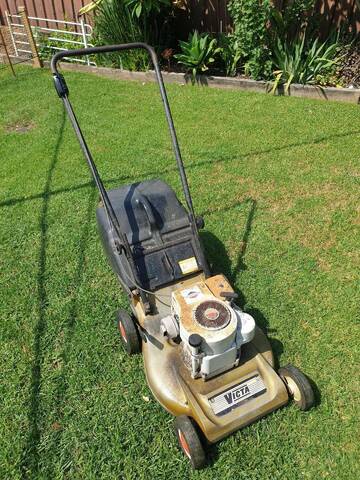
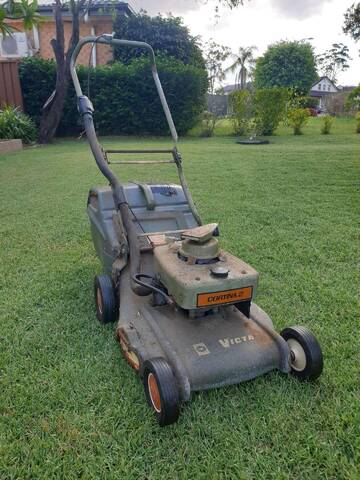
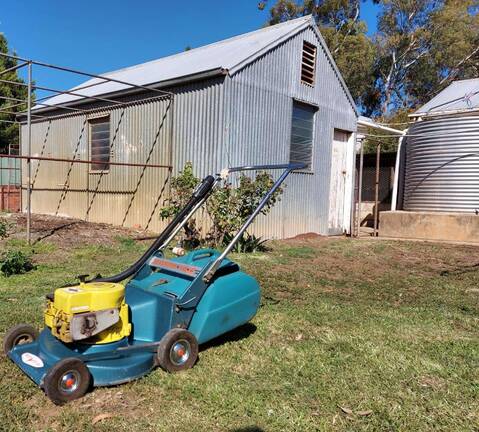
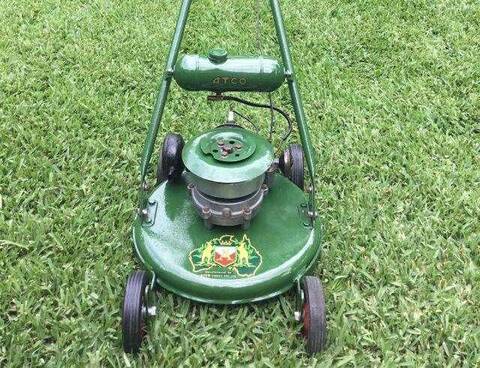
I thought I would write about the paint used on the KXD-2.
As Paul informed me in an earlier post, the type of paint used on these mowers is called "hammertone". I have been trying to track down a modern spray paint that provides a similar effect and has similar shades of the two main colours that were originally used on the KXD-2, being gold and blue. The blue is a mid-range blue, not too light and not too dark.
Having experimented with several different brands, I believe I have found the most suitable replacements:
Ultracolor Hammertone Blue
Ultracolor Hammertone Gold
These come in handy pressure packs, but a word of warning on these: the cans are only 250 grams. Don't be like me and think you can spray an entire frame with just one can. It took two cans of blue to fully cover the top and underside of the carriage with just one coat. As for the gold, two cans gave two coats inside and out on the cowl, and it took another half a can just to do the handlebars.
A second word of warning, although hammertone paints are generally very forgiving in that they can successfully cover up minor imperfections (such as small pits, stray casting specks, and weld marks), they can also be very difficult to work with. Spraying on different angles and from different heights and at different speeds provides an entirely different finish. Also if you do a second coat it will turn out looking very different to the first coat, being more dimpled in appearance with smaller toning changes (giving a rougher, more "flecked" appearance).
Through trial and error I found that by applying one heavy coat I got a finish that was closest in appearance to the original. This was despite the instructions on the can saying to build up the paintwork with light coats rather than one heavy coat. Whenever I tried building up the coats in this way, I ended up with a very rough, dimpled finish. I got to thinking that in a factory environment, these mower parts were probably sprayed in one heavy yet even pass in order to save time.
The best method I found was to keep the spray can moving, but stay fairly close to the work and apply the paint fairly thickly in one even coat. Keep going over it while it is still wet, but allowing perhaps a few seconds for the paint to flash off. Avoid staying in any one place for too long to prevent runs or sags. Hammertone paint is again fairly forgiving in this regard and a few sags will generally go unnoticed. I am not a great painter, so I always end up with a couple sags.
A third word of caution with these products: Wear a respirator, as it is very "fumey", particularly the gold spray paint for some reason!
A fourth word of caution: When these spray cans get close to being empty, stop using them! (I keep them only for doing minor touch up work by spraying some paint on a plastic card and applying with a fine paint brush.) The reason I say this is I had just finished painting the top of the deck with a near empty can and next thing disaster! It "splurted" out about a hundred big blobs of paint all over my perfect art work. It made a real mess. There was only one solution and that was to wipe it all down and sand it off and start again. Took me over an hour to clean off and I had to order more cans.

The only other colours are red and black. The petrol cap is black for which I used a stock standard black spray paint. The best red for the wheels by far is Rust-oleum "Farm and Implement" Massey Ferguson Red.