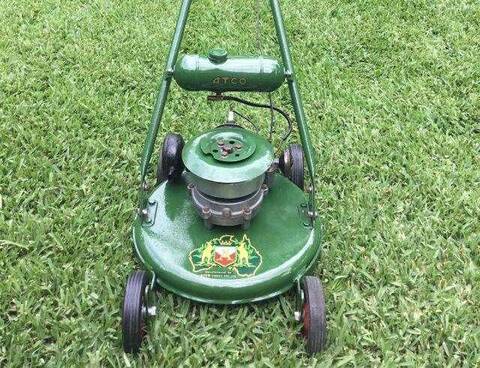
To absolutely ensure that the joint seals properly, you could lap the sealing surfaces. This just requires a sheet of 600 grit wet and dry abrasive paper and a really flat surface [e.g. sheet glass]. Wet the paper [with water is fine], place it on the glass, and move the crankcase half in small circles until the sealing surface is uniformly bright metal. Rinse off with clean water, dry, and it's done.
Thanks heaps for the tip, will have to give that a shot.

Is that to roughen the surfaces so the gasket will bind better, or is it to clean the surfaces so they're clean of crud and allow for flatten even join?
No, it's to get both surfaces really flat - distortion sometimes occurs near the bolt bosses over time, and this procedure corrects that problem.
If the bend is only at the start of the threaded section, as it appears to be, it's quite feasible to straighten it. The best way is with a press, a set of vee blocks, and a dial indicator and base.
Yeh Im pretty sure it's at the threaded section.. unfortunately I dont have many tools mentioned .. only option would be to place it in a vice and try yank on it.

Yes, open bearings are required, so that the oil in the 2-stroke mix lubricates them. The correct types aren't that exy anyway; 20mm x2
HERE and 17mm x1
HEREThe big concern here, with the amount of rust on those old bearings, is the condition of the conrod big end rollers. Does the conrod rotate freely and smoothly, or does it feel a bit 'graunchy'? .... That kit is actually quite cheap!
Oh fantastic, ill have to see how many I need.. i think its only 2x of each bearing ? + the 2x oil seals.
"conrod big end rollers" that bar the piston attaches to ? I had a look, seems to spin freely and smooth ... ill double check... I did notice it's not attached like ones you would find on a 4stroke .. can they be removed? Looking at the pic Blumby posted, it looks like they can separate but maybe they were made as non-replaceable part during assembly ?
2 x 20mm bearings, 1 x 17mm is the requirement.
Righto; the correct technical term for that bar is the 'connecting rod', or conrod for short.
Victa full crankshaft engines use a pressed-up crankshaft assembly, as do two-stroke [and a few four-stroke] motorbikes. Blumbly's parts list shows the component parts of the assembly. It is possible to dismantle and rebuild these, but this requires a serious workshop press and several special tools, so it's seldom done with Victa crankshafts, these days.
Easier and cheaper to just find another crankshaft, if the one you have isn't serviceable for any reason.