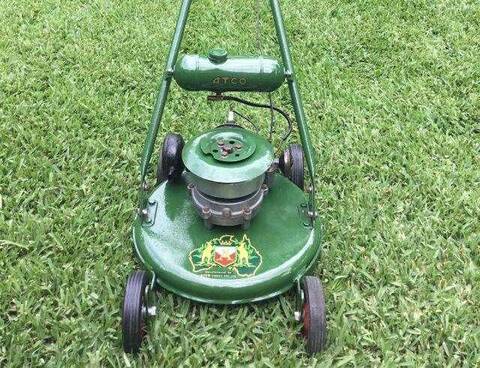
Righto, here we go.
I don't own a 2-stroke mower these days, so I can't do pics of one! Could use my chainsaw if we have to, but see how we go from a verbal description.
Neoprene elastomer lip seals are universally used on the crankshafts of 2-stroke engines, these days. And very effective they are too, in comparison to earlier types.
Their function is to provide an airtight seal, between the moving crankshaft and stationary crankcase. Single-lip seals, the most common type, use a coil backup 'garter' spring around the outer circumference of the 'lip', on the crankcase side, to ensure effective sealing when the crankcase pressure is less than atmospheric; i.e. a 'partial vacuum' exists inside the crankcase.
So when one of these seals fails in service, it will leak air, in one or both directions. The test I describe above uses a low-viscosity fluid, with the crankshaft in the vertical position, as a leak check.
There is enough of an annular void, in the tapered gap between the crankshaft and seal lip, to hold a small quantity of the test fluid. So it can be easily observed if air is bubbling outwards, or the fluid is getting sucked inwards.
This is something of a 'trick o' the trade', for this diagnosis.
I've seen manufacturers' 'recommended service tool' pressure testing setups; complete with blanking plates, squeeze bulbs and pressure gauges, demonstrated at service schools.
But the simple test is just as reliable, and a lot less mucking about. All you need to have on hand is a 'squirt bottle' of some sort, with a bit of 2-stroke fuel in it...