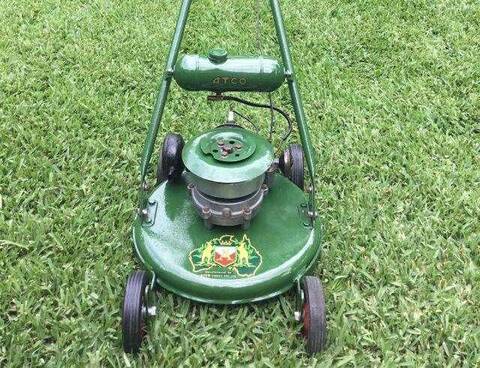
Has anyone turboed a victa on a mower? I typed in victa turbo on YouTube and found a push bike with a victa 160 turbo! Not sure if this is the right place to put this on the forum but it's a customision
It is indeed a customisation Michael. I lack enthusiasm for attaching a turbocharger to a mixed-fuel 2 stroke because a dirty stream of carbonised oil in the exhaust is not good for the turbine's health and longevity. My one and only home turbocharging experiment, on a 6 cylinder Vauxhall about 45 years ago, failed partly because the center bearing of the turbocharger didn't drain its pressure-fed oil well enough, causing oil to be injected into the turbine, which carboned it up so it ceased rotating. As it happens it wasn't a great success anyway: I had a turbocharger of the correct size for the engine's displacement (138 cubic inches), but the intended engine (a Chevrolet Corvair) ran to 6,500 rpm while my Vauxhall tended to bounce its valves at about 4,200, so the gas flow rate was far too low and I only achieved 3 psi boost pressure, which had a barely noticeable effect on the car's acceleration. (The same turbocharger worked excellently on a 179 cubic inch Holden red motor, though.) I'm told most home turbocharging projects fail.
The turbochargers I've had dealings with require pressure-delivery of clean, cool, filtered oil to the center bearing. If they don't get that, the center bearing lasts a very short time. The mass flow of air and exhaust has to be accurately matched to the size of the turbocharger. Even if you do all that and the dirty exhaust doesn't wreck the turbine, crankcase induction 2 strokes do not adapt terribly well to any kind of supercharging, since at best they dump most of the pressure out of the exhaust port during the first part of the compression stroke, so the effects on power output are quite small. In brief I think this is a dumb project, but then I suppose no project is dumb if you have fun and no one gets hurt.
Well I never herd of a 2 stroke turbocharged.As grumpy has said it wouldn't really work however,there have been 4 stroked turbo mowers.Here are some links to some.
There are more but I'm not going through them all.There not hard to find.Just go to you-tube and search for turbo mowers.
Last edited by Bruce; 12/08/1712:41 AM. Reason: Corrected Youtube
I agree with Bob. The turbocharging process can work well on a 4 stroke mower engine but you require pressure feed of clean oil to the turbocharger, and few mower engines have pressure lubrication.
It wouldnt have really worked that well, (I have seen the vids myself) any extra pressure on the inlet side woudld have blown straight out the exhaust when the piston went down and opened up the ports, one positive thing might have been the fuel air mix left over in the cylinder from the firing stroke would be pushed out and replaced with somewhat cooler fuel air mix.
Whenever there was positive inlet pipe pressure, there should be quite decent scavenging of the combustion chamber, so it should two-stroke nicely. However to get positive intake pressure it would have to be running full-song, and would have two-stroked anyway.
Supercharging two strokes can be beneficial, but only if they have the right intake and exhaust timing. The only practical cases I've seen that worked well had pressure lubrication of the engine and did not use crankcase induction. Take a look at a traditional Detroit Diesel: camshaft-operated overhead valves, and a Roots blower to handle the intake chores, but it ran as a 2 stroke. In other words, just build it like a 4 stroke but run it as a 2 stroke. In practice there has been at least one mass production piston-port controlled supercharged 2 stroke diesel that worked pretty well, but like the Detroit Diesel, it had pressure lubrication and did not use crankcase induction. That engine is the Commer TS3, often called the Commer Knocker for the obvious reason - its diesel knock was awesome.
Both of those engines used a Roots blower to push air into the cylinders, instead of using either crankcase induction or piston-generated suction.
Could somebody put the you-tube link up.I haven't seen the 2 stroke one.I only found 4 stroke ones.I'd like to see it.I can't work out how it would run on a 2 stroke.
That is right Bob, a two stroke has no cylinder suction since the only time the piston moves downward is during the power stroke. So, to achieve induction of air for the next compression and combustion stages, you have to use some other way to pump it in. There are three standard ways: crankcase induction (for small cheap 2 strokes), separate pumping cylinders (in other words a reciprocating air compressor on the same crankshaft as the power-producing cylinders) or a positive-displacement supercharger, usually a Roots blower, such as the Detroit Diesel and the TS3 used. The advantage the valve-controlled engine like the Detroit Diesel has is that the valve timing does not have to be symmetrical in the two piston strokes, which lets you achieve more power and efficiency. I once had a piston-controlled ported two stroke motorcycle that achieved the same thing by tricky design: Original, and more information, is on this site: http://berniesbikeshed.wordpress.com/splitsingles-and-what-they-are/ They even have a picture of my motorcycle, labelled 250SGS. Mine was red, though.
The idea is that the master-slave connecting rod arrangement places the big end bearing for the rear cylinder some distance rearward from the front cylinder, so the piston movements are somewhat different. By putting the transfer port on the rear cylinder and the intake and exhaust ports on the front one, much better scavenging can be achieved. Note there is only one combustion chamber across both cylinders, which is why it is called a "split single". For a while before WW2 the manufacturer, Steyr-Daimler-Puch, supercharged this engine for racing. The separate timing of the transfer and exhaust ports makes it (barely) feasible to close the exhaust port before you close the transfer port.
The conspicuous advantage the split single's superior scavenging had for road use, is it idled rather smoothly and two-stroked from just off idle, even at little or no load.
The 2 stroke Detroit Diesels had many supporters, Bob. One of the things the drivers loved was the exhaust sound, and the three foot flame from the truck's exhaust stack at full song. (This was not considered a positive feature when hauling cattle however, the beasts found it unsettling.) The company I used to work for had a couple of Detroit Diesels in the emergency power supply for the mainframe computer: a 16V92T to run the full system, and a 12V71 to just keep the mainframe itself ticking over while the 16V92T was being serviced. Running 24/7 in an emergency "no mains power" situation, the big one had to be serviced every Sunday. Ah, the old days.


![[Linked Image]](https://www.outdoorking-forum.com.au/forum/uploads/usergals/2011/11/full-2772-4153-puch.png)