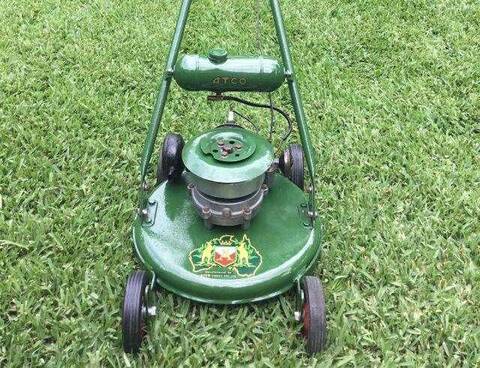
I've had a lot of newish Sprinters that don't kick back Norm ,The old Sher drills are awesome ,In 1967 the American Skil Corporation took over Sher Tools Australia, too bad about the drill.
Before you throw a motor out you should take it apart and check the ACR.
I usually just do the easiest tests first for kick back, the following isn't in any order to do, just a list, too much valve clearance ,exhaust valve not opening correctly ,incorrect ignition timing ,coil too close to flywheel ,broken or cracked key on flywheel ,broken key on blade hub , not enough flywheel weight to overcome the compression stroke, spark plug or coil needs replacing ,the automatic compression release is malfunctioning (acr). Don't adjust valve clearance at Top Dead Centre, use proper instructions,restricted or blocked exhaust ,excessively carboned up ,over fueling ,worn rings, bore, piston allowing oil into the combustion chamber, crank case ventilation pumping oil into carby, oil level too high.
I've left the fuel tap on for over a week now and the needle and seat isn't leaking any fuel and 2 primes and the mower starts.
I was looking at one primer cap with a magnifying glass and where the taper is cut in the seat there was a bur sticking outward, this makes me wonder when people have problems with the needles if you just need a milling tool to remove a bur.
If there was a problem with the seat in the cap you could make an alignment tool in a lathe to centre the seat in the cap and make a tool to polish the seat in perfect alignment using valve grinding paste.
Latest disaster with these. Brand new primer cap, brand new needle polished the seat and spring clip. Can't get it started. A second brand new primer cap, new needle polished seat, spring clip. Fired straight up but then started pissing fuel out of the primer bulb while it was running. I am just about done with these Victas, they are just not worth the hours spent fighting with float needles and primer caps, they will go to the scrap before too long
Please send to me the two complete carby assembly which pissing fuel and doesn't starts. I will investigate and provide solution to you and to everyone especially you have plenty of primer caps and needle. Send few needles and caps as well. Once done, I will send everything back to you.
I had a couple that wouldn't start lately too but I knew the needle wasn't getting stuck which just left the primer as the problem, one primer if I held my finger over the plastic hole on the inside then pushed the black primer bubble I could hear the air escaping from the rubber bubble to the plastic mount so that cap is useless and the other cap the primer tested good (no air leaking) but would still not prime ,the problem was the cap o ring was leaking (if you measure your cap where the o ring sits and it's slightly under size to the old cap the o ring may not seal, sometimes the o ring will leak air at the top so fuel doesn't drip out but the primer doesn't work. I put the same cap on another carby with a new O ring and the primer worked well. These primer caps were second hand .
As we know the fuel bowl is sealed and the air vent is the small hole in the rubber primer bubble ,pushing the bubble pressurises the fuel bowl and fuel is forced into the main jet.
Not sure why so many are leaking for you Norm ,I put a metal needle and clip into a Victa 460 Utility today and it worked well but I did notice some floats are different ,one float looked almost bottomed out with the needle closed so I used a different float and the float looked in a lot better position.
Hi Max, I am very particular about the floats and check everyone up to the light so I can see exactly where it is sitting. I have worked on motors for 60 years so I have a rough idea how things work but these things just smash my head.. I would not be complaining if I was having trouble with old primer caps, I have used plenty of those and if I get a problem one I then use a new one and that is a 50/50 anyway Hi CM, thanks for the offer but it is not worth the trouble, I am just about done with these carbs, great design but so badly let down by float needles and primer caps.
Yes Norm there shouldn't be a problem with these new parts but there has to be a reason why the new caps and needles are leaking.
If it was me I'd be putting all the assembled leaking needles ,caps and floats aside and testing and measuring everything, comparing them with working caps ,needles and floats to see any differences.
I didn't think you can assemble them wrong Norm as they are new parts as you say but something somewhere must be different with the caps to get this problem.
I'd be interested in comparing the ones that don't work to working ones Norm ,If you keep the leaking primer caps with needle and float together.
Hi Max, Problem is I keep trying, then I mix needles and caps till I get something that works. Then I ended up with a small container that I put needles that don't work, either sticking or flooding so really now I don't know what is what. Once I get a pair that work they usually are good and I don't often get people coming back with problems, I do get them but hard to tell because I haven't sold many over the last 12 months or so. They have driven me mad and I don't think I have the interest in fighting with them anymore, they are just too problematic. It is very hard to tell what the seat is like but they look almost flat with no taper on the seat which can cause either the edge to grab the viton or vise versa not seal. I polish them all but I'm not sure if that is enough with the flat seat
Hi Max, I have diamond needle point files here I might have a go at putting a slight taper in the seat with the file in the battery drill I have tried one with the file on the seat and it might work, just taking the square edge off the seat and then polish it with the cotton bud and autosol. So far it seems to be shutting off and allowing fuel to flow with little float movement. Even putting pressure up on the float doesn't seem to be causing the needle to stick in the seat. Time will tell Cheers Norm
I'm not sure if the angle would be right on a file but may work if the angle is right , I was thinking of a grinding stone as you can shape it to any size and angle or possibly an engraving tool , I think the seats are cut at 60 degrees. It shouldn't too difficult to make or get something the right size ,the cut would have to be very small , even to machine up a metal shape the right size in the lathe and use valve grinding paste would work .
What I will try now is file and polish 5 primer caps and with a carby that I know is working properly fit the 5 primer caps and needles and see what results I get with each one. Then I will keep each set in individual containers so I can then fit them to carbys as I need and see if they work after sitting for some time. Very tiring but I have to do this before I commit to picking up another 30 motors. If they don't work I am done with them
The only problem I see Norm is if the angle cut on the seat isn't 70 degrees then the needle will have less contact.
I had a small 3 mm shaft rotary white stone that I would shape the angle of the stone with a bench grinding wheel dresser tool and that worked well to countersink any angle I liked.
The one I had was from an industrial supply shop and was a few dollars.
I advise not to change the 70° chamfer. Last night I have done comparison with the new primer cap untouched and retouched one. I have observed differences and improved on the surface contact (improved sealing property) and needle sticking. I think I need to do this properly on all our remaining stocks. I think this is overseen during manufacturing.
That certainly looks tapered I will have a look at some of the old one I have here. How did you pull the seat out, I have pulled them out before by screwing into them but this would mark the seat so be difficult to see what the seat looks like
I tried to extract the seat Norm but yes it will damage the seat as they are tight so I just filed behind the seat and pushed the seat from the other side as the cap had a broken primer bubble anyway.Only took a few seconds.
I tried that idea MF but the failure rate is too high and it is the hours I waste fighting trying to get a set that work, on and off the bench is driving me crazy. Never in my entire life have I ever had so much trouble with such a simple thing as a float needle
I've repaired G4 carbs since the eighties and any that were leaking I would put a new plastic needle in the carby and had no more flooding issues but we are talking about genuine Victa parts.
It does sound like the caps without the taper is the problem.
Industrial supply shops sell an 80 degree tool for about $20.
Ok this seems to be working, give it a good file in the battery drill, then polish the seat with Autosol. I can put a needle in and push up hard on the float and the needle doesn't stick in the seat and so far they seem to be shutting the fuel off. This was on primer caps that were holding the needle up in the seat so now I will set up a test carby and try a number of caps and needles and see if this has solved the problem. I don't think the file is cutting much off the seat but it is removing the sharp bur on the seat that was biting into the viton and causing the needle to stick. I hope this is the end of this never ending saga. Time will tell
Ok first test new needle, new primer cap that has had the seat filed, no sticking needle, no pissing out the primer bulb, gentle pull and it fired up perfectly. So one out of one is not a real test so I will try some more but I believe this is the answer to all the problems I have been having. Wish I tried this years ago would have saved me a lot of grief Ok now 3 out of 3 working perfectly straight up, no leaking, no sticking, so this is the answer, the seats need filing. I have only tried this on new caps and needles, now I will try using new caps and the needles that are in my reject bin because they either stuck or wouldn't seal. I expect they will all now pass without problems
I think you're on the right track and I have confirmed with microscope. I have removed one seat from a new primer cap. I knew there must be something on the top of the chamfer which you may suspect is a burr which is biting the viton tip and yes, you're right, there is. There is a slight bulging and microscopic burr around the top of the chamfer. This is due to the manufacturing process using manual press. The seat was machined using an advanced 7-axis CNC machine but the chamfer was done the final stage using manual press. During this chamfer press process with center guide, it pushed the top edge outward to create a slight bulge and microscopic burr. I will get back to the manufacturer to give them feedback about this finding and suggest them to improve the seat surface on our next order but at the moment I have to do all the mods myself on our remaining stocks.
Mowerfreak, You may need to modify your new primer cap to improve surface contact and sticking needle. You can follow this easy solution I did below.
My solution: Using a 3.7mm trimmer string rod with flat end for sanding the seat with 3.7mm sanding disc attached. . Punch-hole a 3.7mm 1000gritts sandpaper disc and glue it into one end of the string rod above. Use the rod with sandpaper disc on the tip on sanding the seat surface by spinning the rod by hand. No need to use drill or power tool to spin the rod. Use NormK autosol method for final sanding.
This really works great and shows a big improvement.
With unmodified seat, I can still observed needle sticking even when fitted with the new float lever. When quickly releasing the float, it took a second before the float drops. The sticking needle is holding the float for a second.
When modified and quickly releasing the float, the float will just drops instantaneous from zero to its gravitational fall.
Overall, there's no need to spend to source for special tool. There's no need to chamfer or grind the seat as it's already been perfectly chamfered at 70° for maximum surface contact with viton tip. Do not sand or modify the viton tip rubber. Only use the method above to remove the bulging and burr.
On the attached photos, the tip of the rod with sandpaper, a ring mark concentration on the center is very noticeable is due to the seat bulding in contact with the sandpaper disc.