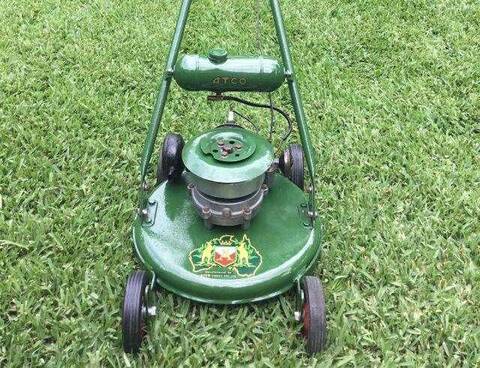
Briggs recommends that a tilt angle of 15 degrees should not be exceeded for either engine. However when it comes to guessing at what point lubrication will actually fail, the horizontal crankshaft engine has the dipper on the bottom cap of the connecting rod, which is pretty much in the center of the sump. The vertical crankshaft engine has the oil slinger driven by the camshaft timing gear, which is a bit closer to the opposite side of the sump from the cylinder. This would mean that it did a bit better when it was tilted cylinder-up than cylinder-down. However it doesn't look as if the difference would be very large: Briggs tried to get the slinger as far out into the crankcase as possible without hitting the connecting rod. My guess would be that if you were going to operate a vertical crankshaft walk-behind mower temporarily on an excessive slope - which would be a bad idea for several reasons, including operator safety - it would be best to do it with the slope in the cylinder-up direction, and with the sump temporarily over-filled with oil. When it comes to ride-on mowers, though, I think operating on steep slopes is just too dangerous to contemplate. Even on a slight slope, it would be important to make sure the sump was filled to the full mark on the dipstick immediately before you started, and perhaps every couple of hours while you were mowing.