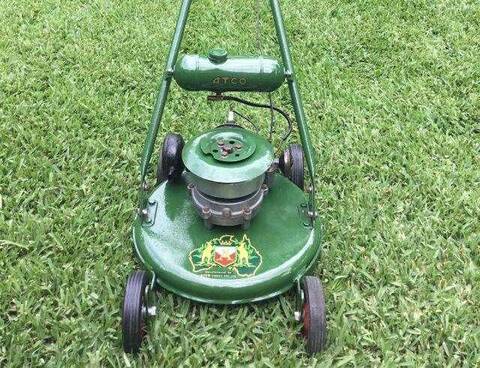
Hi Diablo, welcome to Outdoorking.
Various methods are prescribed by different engine manufacturers, and all of them have disadvantages. I tend to use a flat plate puller if the flywheel has holes for one, but I don't like to drill holes blindly when I haven't seen the design of the inside of the flywheel. I usually use a 6" gear puller on cast iron flywheels but I don't like to do this with aluminium ones. You may be interested in the method Tecumseh prescribes for some of its engines:
![[Linked Image]](https://www.outdoorking-forum.com.au/forum/uploads/usergals/2014/05/full-2772-16608-tecumseh_lav30_flywheel_removal.png)
![[Linked Image]](https://www.outdoorking-forum.com.au/forum/uploads/usergals/2014/05/full-2772-16609-tecumseh_lav30_flywheel_removal_2.png)
I don't actually recommend this method for horizontal crankshaft engines like yours, because unlike the vertical crankshaft ones, they usually have ballraces for both main bearings, so the axial thrust on the crankshaft is taken by one of the ballraces. (The screwdriver supporting the underside of the flywheel does not seem likely to be very effective, to me. It may just give the crankshaft a running start in moving downward, so it can hit the ballrace with a larger thud.) Nevertheless the flywheel and crankshaft are fairly heavy, so as long as you don't hit the tool too hard or too often, it should be OK. Worst case, you need a new ballrace at the PTO end.
We have a member who uses an air chisel (with a blunt, ball-ended chisel) in the center of the crankshaft, and feels that this is actually gentler than the Tecumseh technique, as long as you keep the air pressure low and the vibration-time down to a small fraction of a second.