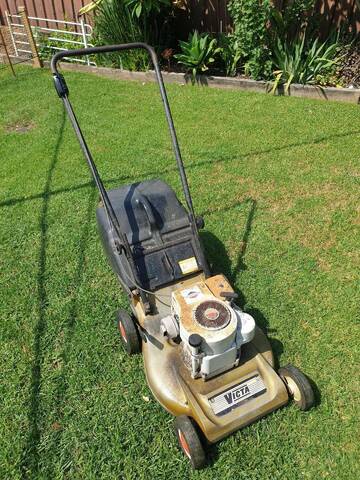
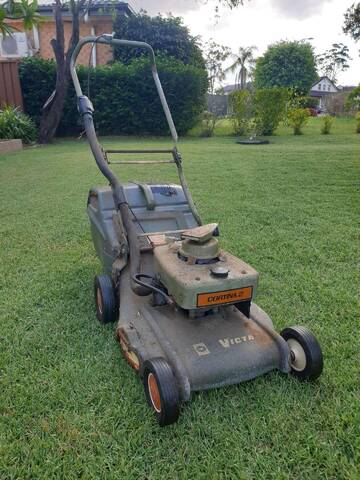
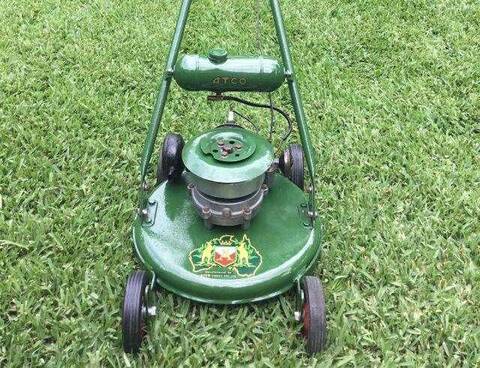
It's getting clearer then, Sally. First, as I understand it that Victa base has two sets of mounting holes (the various types of engines are each held down by 4 bolts), one of which is "standard" and therefore will work for international engines such as Briggs and Honda, and the other is non-standard but fits Powertorque. Two of the holes are the same for both engines, so there are six holes in the base. I'm sure someone will tell me, probably pretty vehemently, if I'm wrong. All that means you can mount the various models of Briggs and Honda engine on the base you have. There is an issue to be checked, however. As I said in the previous post, you will need to buy a blade boss and blade plate to suit the new engine you choose, because the Powertorque blade boss is on a taper while the other engines use a parallel shaft. Victa made and makes lots of mowers with Briggs engines (Victa is owned by Briggs, so that should not be surprising), and I believe from time to time has made some with Honda engines. The engine output shafts for Briggs and Honda engines are of different sizes, so you'd have to verify that you can get a Victa blade boss to suit a Honda engine. You can't use a blade boss made for a Honda mower, because the matching Honda blade plate will not suit your Victa base.
You have now said you intend to fit a new engine, not a second-hand one. The next question is how much power you will need. We will have to work in "advertised power" which is a fictitious number for mower engines. The issue is, whether you might sometimes want to attack something fairly challenging, such as foot-high kikuyu, or you are confident that you will only be trimming the grass. The type of base you have is pretty much limited to say a foot of grass: to cut really messy stuff you'd use a utility base, not a catcher base. Even to cut a foot of a relatively tough breed of grass, you'd probably be lifting the front wheels off the ground and shoving the mower into the stuff a foot at a time. For the foot-high kind of work, you would want a more powerful engine than for the trimming approach.
In Honda engines, the OHV models are described as "commercial" and the OHC ones are called "residential", to indicate how long they should be expected to last. Honda's model numbers work like this. All of them begin with G, which just means Honda. Next comes a letter that is X for OHV and C or S for OHC. After that is V meaning vertical crankshaft, suitable for a rotary mower such as yours. Finally there is the engine capacity in cubic centimeters. So, looking at the commercial models GXV120 is an OHV engine of 120 cc, and it has 4 advertised horsepower. The most common type is probably the GXV160, which is 160 cc and 5.5 advertised horsepower. In the residential engines that are commonly available in Australia, there is the GCV160 at 5.5 advertised horsepower, and the GSV190 at 6.5 advertised horsepower.
I think that is about as far as I can get until we find out whether there is a Victa blade boss to suit the standard 25 mm Honda output shaft (called a "Power Take Off" or PTO in the trade).