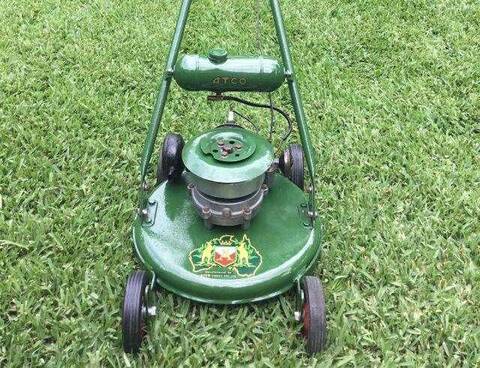
bazz, in the video the guy is working on a vertical crankshaft engine, he emphasizes that he is using a very small rattle hammer, and as you said, the flywheel comes loose very quickly. If it is done exactly that way, it is probably a good method for flywheel removal - but only for vertical crankshaft engines. This is because all vertical engines AFAIK, have a plain main bearing at the PTO end. (The engines are designed that way because the bottom main bearing of a vertical crankshaft engine is exposed to major impacts when blades strike stones and pipes, as well as having to live in sludge city. I can't imagine a ball race surviving there.) If you hammer axially on the flywheel end of that type of crankshaft, the hammer blows are absorbed by the plain thrust bearing at the PTO end, and for just a few fairly light blows, a plain thrust bearing should be able to handle it. Horizontal crankshaft engines, however, frequently have ball races at both ends of the crankshaft. I have no enthusiasm at all for using either an old-fashioned hammer or a new-fangled rattle hammer, on a ball race, including the one at the PTO end of a crankshaft.
Hence in my opinion the use of a small rattle hammer very briefly on a vertical crankshaft engine to remove the flywheel makes sense. Using a bigger rattle hammer, or a multi-second burst of hammering, is a different situation however.
Years ago I used to complain about people assembling engines with rattle guns, because they rarely reduced the torque to a safe level for the parts concerned, and even used 12 point sockets instead of 6 point, so they ruined the hexagons on the nuts as well as often stripping the threads. Realistically however, that is blaming the tool itself for the fact that it is being used by an idiot. I took that negative attitude because nearly everyone I saw doing it that way was indeed an idiot. However it is bad science to extrapolate, and bad logic to blame the tool for having an incompetent operator. By now there may well be people in the trade who are competent to adjust the torque to suit the bolt they are doing up. (I'm not too sure that any of those new improved people work in tyre shops though - I still seem to see most of those guys ruining every wheel they attach to a car.)