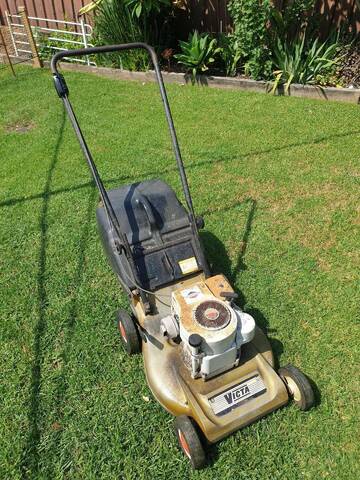
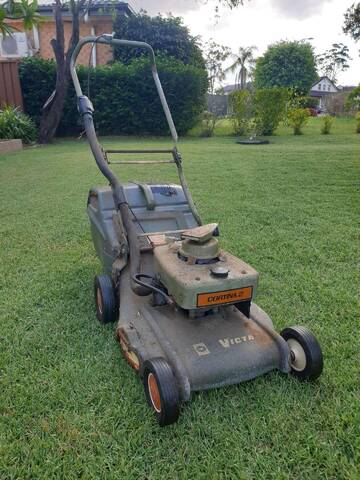
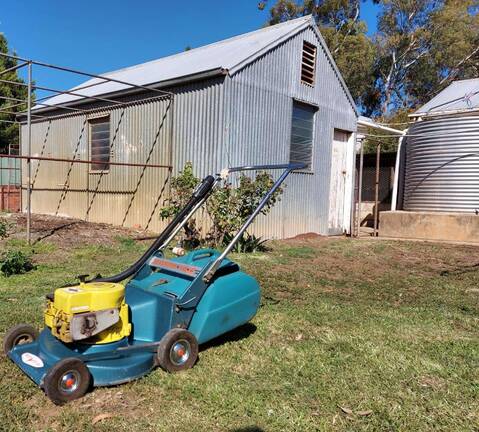
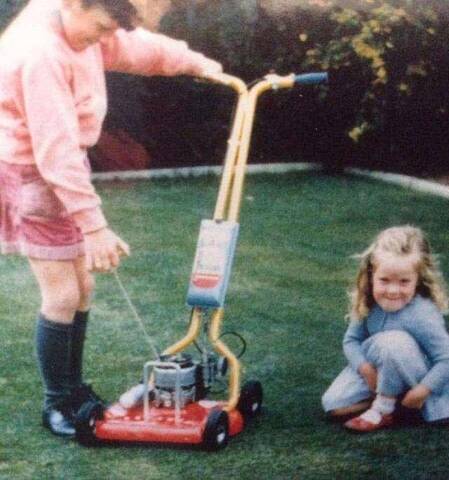
The white one may be very old - my white Briggs was made in 1976, and soon afterward they seem to have turned orange. It is probably a 92908 - you can find out by reading the numbers stamped on the air cowl. The model (92908) is the first of three blocks of numbers, the second is the type (obscure topic) and the third is the code. The first two digits of the code are the year of manufacture. Briggs engines from before 1982 have breaker points. This is not much of a source of trouble, but eventually the ignition cam follower wears the crankcase resulting in oil entering the points can inside the flywheel, and shorting the points. If a new cam follower doesn't tighten it up, this requires reaming and bushing the crankcase, so it isn't really worth bothering with - it only takes a couple of minutes to fit the electronic ignition from post-1982 engines. The 92908 in particular has an automatic choke, which is excellent when working properly and is normally easy to service, but if it has been butchered it may be a problem. Also, some of the later 92908 and 92508 engines had plastic (Minion) carburetors which work until they deform, and then are a problem. The vertical pull starter is excellent - pretty much lasts forever and is easier to use than the radial pull type used on all Briggs horizonal crankshaft engines, and the later Briggs vertical crankshaft engines. 92908s with breaker points have an oil level plug, not a dipstick, and this is not as easy to use as the dipstick. Generally, I consider it one of Briggs' best small engines: easy to start, nice to use, reliable and durable. Like all of the small Briggs engines since about 1970 it has an aluminium bore, of course. There is excellent overhaul information on that engine and many others available in the old Briggs overhaul manual, accessible free on the internet. I don't recognise the red engine you've described, but if it has the vertical pull starter it is probably 1980s. I'd need the model number to be more specific.