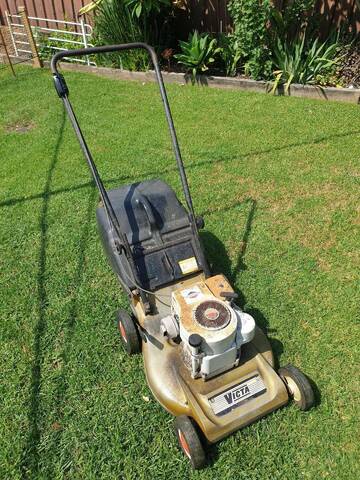
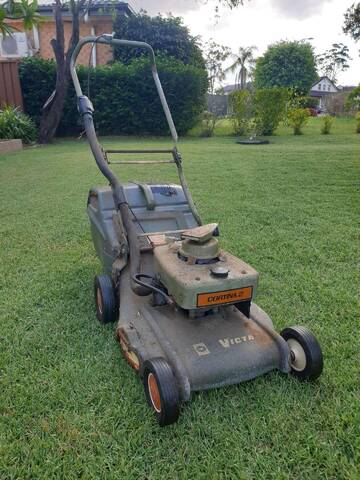
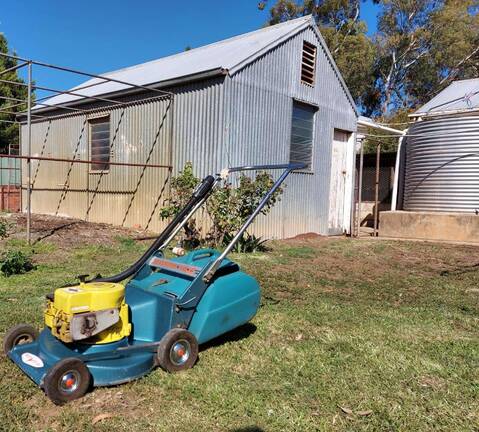
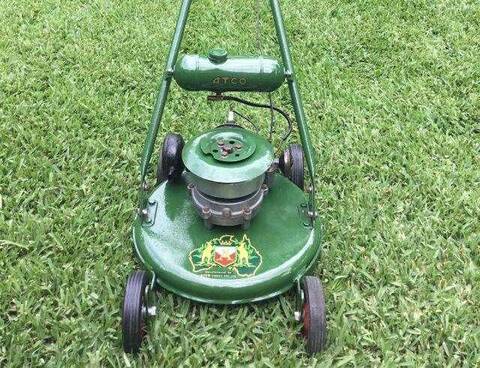
Mainly because of storage issues, not long after getting the Rover running again, I ended up loaning out this mower. It's role was to cut a particular lawn extremely short, think putting green type of thing. Being an Aussie designed and made mower, this was easily achieved using the Rover. However, about a month ago the Rover was returned to my care.
I had changed the oil on site back in September, but upon return I wanted to do some servicing........................and satisfy my curiosity. If you remember, my theory was this mower/engine hadn't done much work. So, I decided to pull the cylinder head and see for myself.
![[Linked Image from i.postimg.cc]](https://i.postimg.cc/jqmZy86f/IMG_3691.jpg)
After removing the eight remarkably clean head bolts and the two smaller bolts holding recoil, I gently lifted the head away from the block. The piston was also remarkably clean, and while it looks bad in the photo's, the head wasn't too bad either. Compared to the oil-burning Sprint from a couple of months ago, this one looks quite reasonable. The intake valve was pretty crusty though.
![[Linked Image from i.postimg.cc]](https://i.postimg.cc/jdfvczvF/IMG_3693.jpg)
![[Linked Image from i.postimg.cc]](https://i.postimg.cc/3xH1cdcJ/IMG_3694.jpg)
I then went about cleaning up the head, block and piston, removing any remaining gasket material in the process. I also sanded the head on the bench to level down any warping and create a level gasket surface. You would probably do that with the block as well, but I wasn't removing the engine or all the surrounding parts to make that possible. The valve faces were cleaned, and I did my best with the valve seats.
![[Linked Image from i.postimg.cc]](https://i.postimg.cc/h4f2zFmg/IMG_3696.jpg)
![[Linked Image from i.postimg.cc]](https://i.postimg.cc/wxykxXKj/IMG_3699.jpg)
After cleaning the block and head with carb spray, it was then time for reassembly. For the head gasket, you need to be careful when ordering these. Despite these flat-head engines being largely unchanged over many decades, Briggs did change a lot of parts over the years, head gasket included. This is where your model-type-code number comes into the equation, which helps narrow down what parts your engine needs. For this vintage Quantum, I needed the 272200 or 272200S head gasket.
![[Linked Image from i.postimg.cc]](https://i.postimg.cc/Kz4DMLRQ/IMG_3701.jpg)
With the recoil cover still on the machine, it can be tricky getting the head levered up under the cover plate, then aligning the gasket and at least two head bolts with the block. Once located properly, I then fed in the rest of the bolts, getting them started by hand then seating them with the impact driver. Important to note that I didn't torque them down with the impact, I just ran them down till the first click and then followed with a torque wrench. I know there is probably an official torque sequence, but I just follow a cross pattern, the first round to 10 Nm, then followed by the suggested 16 Nm..............actually, I did them at 17 Nm.
![[Linked Image from i.postimg.cc]](https://i.postimg.cc/mrLwTK4v/IMG_3705.jpg)
If you are looking for a good torque wrench, I can certainly vouch for these Wera items. This particular one is the A5 with 2.5 to 25 Nm capacity, and I also have the C4 with 60 to 300 Nm capacity. They have a lovely positive click-click action and the handles are super ergonomic. I also love the positive click for each increment up or down, and the clear indicator. Certainly not the cheapest, but also not the most expensive, especially if you buy them from Amazon.
https://products.wera.de/en/torque_...reversible_ratchet_click-torque_a_5.htmlhttps://products.wera.de/en/torque_...sible_ratchet_click-torque_c_4.html.html![[Linked Image from i.postimg.cc]](https://i.postimg.cc/1RKvHKrK/IMG_8993.jpg)
![[Linked Image from i.postimg.cc]](https://i.postimg.cc/wMFFj6jr/IMG_8995.jpg)
![[Linked Image from i.postimg.cc]](https://i.postimg.cc/TPt0XjxN/IMG_2501.jpg)
![[Linked Image from i.postimg.cc]](https://i.postimg.cc/1z6gKJwR/IMG-8985.jpg)
With the head back on, I turned to some more basic service items. Although probably unnecessary, I started by fitting a new spark plug.
![[Linked Image from i.postimg.cc]](https://i.postimg.cc/dVvR9ghh/IMG_3709.jpg)
Next, the filters. Both the paper panel filter and foam pre-filter were dirtier than expected. I could have blown out and/or washed them, but I don't have the patience for that, so I just replaced them. The items that came out of the machine were aftermarket parts, the ones that went in are genuine Briggs.
![[Linked Image from i.postimg.cc]](https://i.postimg.cc/RCKnbX5K/IMG_3711.jpg)
![[Linked Image from i.postimg.cc]](https://i.postimg.cc/HnD8k75r/IMG_3713.jpg)
It was then time to fire it up for a test run, which started on the first pull and settled into that sweet idle.
![[Linked Image from i.postimg.cc]](https://i.postimg.cc/zXkHqvff/IMG_3715.jpg)
I love these engines, they are so simple to work on and seem to run much nicer than the later versions with their fixed speed carburetors. That means they can actually idle and then have enough fuel for high rpm running. I also find people like to dismiss Briggs engines, and to a certain extent I can see where they are coming from. But with appropriate care and maintenance, they can certainly go the distance.
On this occasion, removing the head wasn't really needed. However, after seeing the condition of the piston and those head bolts, it sort of confirmed my suspicion that this engine hasn't done much work.